Australia doesn't have a community energy technology problem. It has a participation problem.
Millions of Australian households already generate electricity. Rooftop solar is now one of the country's largest sources of generation. Batteries are becoming commonplace. Electric vehicles are emerging as mobile energy assets.
The technology required to support community energy already exists.
What Australia lacks is the legal and institutional framework that allows communities to participate collectively in the energy system.
That is the next challenge in the energy transition.
Understanding the European Union framework
Australia has many of the technologies required to help communities generate renewable energy, share electricity and upgrade homes. Millions of households have solar panels. Batteries, electric vehicles and flexible energy systems are spreading quickly. Yet communities that want to act collectively still operate within a regulatory system designed for another era – one built around individual consumers, retailers and network businesses rather than shared participation.
Every project must effectively reinvent the rules.
Europe offers an important lesson. Rather than treating community energy as a series of demonstration projects, the European Union recognised energy communities as participants in the energy market with defined legal rights and responsibilities.
That distinction has changed how projects are financed, regulated and delivered.
The framework in the European Union spans four key legal directives.
- The Internal Electricity Market Directive recognises citizen energy communities and supports energy sharing.
- The Renewable Energy Directive defines renewable energy communities and requires Member States to establish enabling frameworks.
- The Energy Efficiency Directive promotes an efficiency-first approach and access to advice.
- The Energy Performance of Buildings Directive requires one-stop shops to help households renovate buildings.
These measures give communities legal standing. They also create a basis for market participation, network access, consumer protections, public funding and private investment.
Legal recognition changes the starting point for every project. Regulators, financiers and network businesses can deal with a defined participant that has established rights and responsibilities. Communities can use standard structures instead of negotiating a bespoke solution each time.
The results still depend on implementation. European Union Member States are required to transpose the directives domestically but have implemented them with varying levels of ambition. Complex registration processes, restrictive network rules and poorly designed charges have, in some jurisdictions, slowed development. However, strong enabling frameworks have produced much faster growth elsewhere.
Australia would face the same challenge across the National Electricity Market and individual states and territories. A national framework could establish common rights and protections, while allowing individual states and territories to develop arrangements suited to their networks, housing and communities.
Four institutional models worth adapting
Legal recognition is only part of the story.
Europe's experience demonstrates that successful community energy markets are supported by institutions that reduce complexity, build capability and allow projects to be replicated rather than reinvented. Examples of those institutions include:
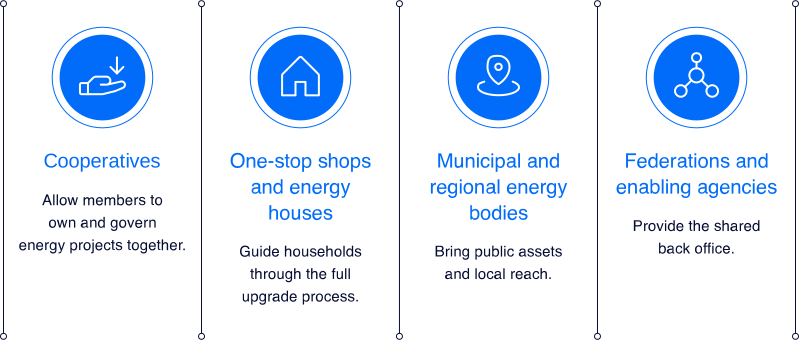
- Cooperatives allow members to own and govern energy projects together. Their value extends well beyond ownership. As projects accumulate experience, they build credibility with financiers, attract local capital and develop long-term relationships with delivery partners. Each successful project makes the next one easier to develop.
- One-stop shops and energy houses guide households through the full upgrade process. They can assess a home, identify suitable work, explain funding options, coordinate suppliers and check quality. For households, they simplify decisions. For governments they improve program delivery. For markets, they lower transaction costs.
- Municipal and regional energy bodies bring public assets and local reach. Councils can contribute rooftops, buildings, electricity demand and relationships with residents. Regional bodies can share specialist staff across several municipalities, giving local projects access to expertise that a single council or community group could not afford. In practice, they become market makers rather than simply asset owners.
- Federations and enabling agencies provide the shared back office. They prepare legal templates, advise on governance, train organisers, connect projects with finance and represent communities in regulatory processes. Their support allows local groups to concentrate on members and delivery.
The strongest European arrangements combine these functions. The community provides local knowledge and trust. The one-stop shop manages delivery. The municipality supplies reach and legitimacy. The federation provides scale and professional support.
What can Australia do to build similar models?
Whilst not all aspects of the EU models are directly transferable, Australia can start with five practical steps to enable greater community energy participation.
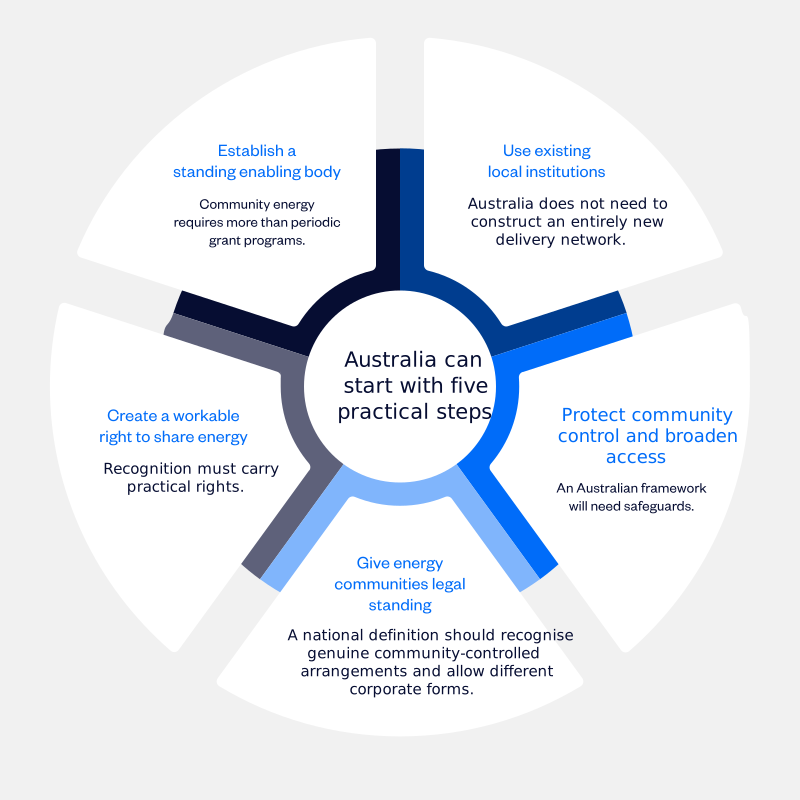
Give energy communities legal standing
A national definition could recognise genuine community-controlled arrangements and allow different corporate forms.
The definition should address participation, control and community benefit. Those safeguards would help prevent a commercial provider from applying a community label to a product that gives participants little influence or value.
Create a workable right to share energy
Recognition must carry practical rights.
The rules need to cover network access, metering, settlement, billing, retail arrangements, data and consumer protection. Charges should reflect the costs and benefits created by local energy use and should apply transparently.
A legal definition has little value when a project cannot use it to operate.
Establish a standing enabling body
Community energy requires more than periodic grant programs with limited support for implementation.
A dedicated enabling function should provide standard documents, technical support, project-development funding models, training and a consistent point of contact for regulators and network businesses. It could operate nationally with delivery partners in each jurisdiction.
Stable support would also allow expertise to accumulate. Each project could build on the work of the last.
Use existing local institutions
Australia does not need to construct an entirely new delivery network.
Regional organisations of councils, local energy groups, community housing providers and other established bodies already have relationships with households. Governments could add community energy and home-upgrade functions to suitable organisations, supported by a shared national or state-level technical platform.
Local government should provide capability, assets and legitimacy while preserving meaningful community participation.
Protect community control and broaden access
An Australian framework will need safeguards.
Large retailers, technology providers and aggregators will play important roles, but community participation should carry substance. Governance rules should protect members’ influence and ensure that benefits flow back to participants or the local area.
Equity also needs to sit inside the model. Homeowners with capital are usually the easiest group to reach. Renters, apartment residents, social housing tenants and households experiencing energy hardship require different pathways.
Councils, social landlords and community housing providers can help extend shared energy and upgrades to people who cannot install their own assets. European programs have used public rooftops, social housing portfolios and reserved participation to widen access.
The window is open
Australia’s energy system is already becoming more local. Rooftop solar, batteries and flexible demand are moving generation and decision-making closer to households.
Law and policy now need to support collective participation.
Australia should define energy communities, create practical sharing rights, provide fair network access and establish the institutions that help projects develop. A connected network of local organisations can then adapt those foundations to different communities and regions.
The choices made now will shape the sector for decades. Clear rules could support a durable community energy market. Delay will leave communities working around a system built for a different energy age.