The changes introduced a mandatory and suspensory regime, giving the Australian Competition and Consumer Commission (ACCC) greater power to assess deals before they can proceed.
The regime is complex and any failure to notify applicable transactions to the ACCC may result in a deal being voided.
Whether you’re an Australian business, overseas investor or a global law firm managing cross-border deals, understanding these reforms is critical.
The important details
Notifiable acquisitions must not close or be put into effect until after they have been approved by the ACCC (or the Competition Tribunal, on review).
The consequences of not notifying are significant:
the transaction is voidable (i.e. it may be voided if the Court orders, on application by the ACCC to the Federal Court); and
substantial penalties and other orders can also apply.
Notifiable transactions and thresholds
Under the new regime an acquisition must be notified where each of the following are satisfied:
it involves a person acquiring assets or ‘control’ of an entity through a share sale;
it meets the monetary thresholds or is subject to a specific ministerial designation; and
the target is ‘connected’ with Australia.
There is the ability for parties to seek a waiver from the ACCC and certain exemptions may apply.
Importantly, it is no longer relevant whether an acquisition is likely to raise a potential competition concern, eg, due to combined market shares. If your deal meets the monetary and other thresholds, you must notify the ACCC regardless.
Understanding ‘control’ under the new ACCC merger rules
In the case of a share sale, notification is required if a transaction gives the acquirer ‘control’ of a body corporate. This concept is defined broadly and will apply in any case where either:
you are acquiring a majority stake
you (either alone or with associates) have the capacity in a real and practical sense to determine the outcome of decisions about the target entity's financial and operating policies. This test focuses on practical influence and involves considering all relevant facts and circumstances, with particular regard to the nature of the relationship between the acquirer and its associates in relation to the target entity.
There are exemptions for acquisitions of shares where:
the acquirer does not, immediately post‑transaction, control the target; or
the acquirer already controlled the target pre‑transaction.
A safe harbour applies to listed companies (or unlisted companies with more than 50 members (widely held companies)) where the acquirer obtains less than 20% voting power or already has over 20% and is acquiring additional shares.
Acquisitions falling within the following scenarios must be notified if they meet the monetary thresholds:
Acquisition of shares in a company that is not a Chapter 6 entity or listed on a foreign approved stock exchange, where the acquirer’s voting power increases from <20% to >20%. However, to ensure that only acquisitions of material voting power over the entity are captured, when calculating an acquirer’s voting power, the votes of entities which are considered associates only because they have entered into, or have proposed to enter into, an agreement with the person for minority shareholder protection rights should be disregarded.
Acquisition of shares in any body corporate (listed or unlisted, foreign or domestic), where the acquirer’s voting power moves from >20% but <50%, to an end point that is >50%. In calculating an acquirer’s voting power, the votes of entities who are considered associates only because they have entered into, or have proposed to enter into an agreement with the person for minority shareholder protection rights are also to be disregarded.
Where the target is a Chapter 6 entity, and:
The principal party already controls the target, and the voting power moves from < 20% to > 20%.
The principal party does not control the target immediately before or after the acquisition, and the voting power moves from < 20% to >50%.
In some cases, minority stakes (under 50%) will offer sufficient influence to be considered a controlling interest. There is uncertainty about how this test applies to companies subject to shareholder agreements, joint venture agreements, or similar documents that give all members joint influence over the company.
The uncertainty surrounding the control test means that it is recommended you seek advice about notification, even for minority stakes, if your deal meets the financial thresholds.
The primary test for notification is based on the revenue of the parties or total transaction value. Lower thresholds apply for corporate groups with more than $500 million turnover in Australia. Revenue refers to revenue in Australia in the last 12-month reporting period, as defined under applicable accounting standards.
Recent amendments have introduced higher thresholds for acquisitions that do not represent all, or substantially all, of the assets of a business.
When assessing these revenue thresholds, the turnover of the firms as well as any ‘connected’ entities will be relevant. In simple terms, a connected entity of the acquirer captures:
related bodies corporate of the acquirer;
an entity that controls, or is controlled by, either alone or together with one or more associates, the acquirer;
an entity that is under common control with the acquirer by another entity.
A person is considered an associate’ of another person, in relation to a particular company if at least one of the following applies:
- Corporate relationships: both persons are in the same corporate group (e.g. they control each other or are controlled by the same parent entity).
- Agreements to influence: one person is acting, or plans to act together with the other person to influence the target entity’s financial and operating policies.
- Agreements to act in concert: one person is acting, or plans to act together with another person, to control or influence the target entity’s financial and operating decisions.
This language expressly ties the associate definition to relationships that involve controlling or influencing the target's financial and operating policies – in other words, relationships that could practically influence competition.
Express exceptions also apply, including due to minority shareholder protection rights, dividend-policy agreements and more. The Minister also has powers to determine classes of agreements, rights, or matters relevant to the associate analysis.
Economy-wide thresholds
The combined revenue of merger parties (including relevant connected entities) on contract date is ≥$200 million and either:
For the acquisition of shares:
Revenue of target (including connected entities) is ≥$50 million;
Transaction value is ≥$250 million (calculated as the greater of market value or consideration under sale agreement)
For the acquisition of assets where the assets form all or substantially all assets of a business:
Revenue of assets being acquired is ≥$50 million; or
Transaction value is ≥$250 million (calculated as the greater of market value or consideration under sale agreement)
For acquisitions of assets where the asset does not form all or substantially all assets of a business:
Transaction value is ≥$200 million (calculated as the greater of market value or consideration under sale agreement)
Note: Where the acquisition is of all, or substantially all, of the assets of a business, the amount to be calculated for the purposes of determining whether the monetary threshold has been met is the Australian revenue of the target to the extent that revenue is attributable to the business.
Acquisitions by very large groups
The acquirer (including connected entities) has revenue on contract date of ≥ $500 million and:
revenue of the target (including connected entities) is ≥ $10 million (where the asset(s) form all or substantially all assets of a business);
transaction value is ≥ $50 million (calculated as the greater of market value or consideration under sale agreement), where the asset does not form all or substantially all assets of a business.
Note: Where the acquisition is of all, or substantially all, of the assets of a business, the amount to be calculated for the purposes of determining whether the monetary threshold has been met is the Australian revenue of the target to the extent that revenue is attributable to the business.
Cumulative (or serial) acquisitions
As well as thresholds that apply to the standalone revenue of a target business, there are also thresholds that apply to similar transactions undertaken over the last three years. These are either:
if the combined revenue of the merger parties (including connected entities) is ≥$200 million and the cumulative revenue from acquisitions by the acquirer (including connected entities) in the past three years involving competitive goods or services is ≥$50 million
if the combined revenue of the merger parties (including connected entities) is ≥$500 million and the cumulative revenue from acquisitions by the acquirer (including connected entities) in the three years before the contract date involving competitive goods or services is ≥$10 million.
When applying this three-year cumulative test, the following are excluded:
transactions involving revenue of less than $2 million;
share acquisitions where the acquirer has not begun, or cannot begin to control, the target body corporate
assets that have subsequently been divested or disposed of, or
if the acquisition is of an asset, the acquisition does not have the effect that a person will, or can, acquire all, or substantially all of the assets of a business, and the market value of the asset is <$2 million.
Exemptions and safe harbours
There is a range of exemptions and safe harbours that apply to particular types of transactions – for example: acquiring less than 20% of shares in a listed company, ordinary course-of-business transactions (including those involving land, but excluding patents), deals where the target’s Australian revenue is under $2 million, and other financial market exemptions
Other exemptions may apply to internal restructures or sale and leaseback arrangements, but legal advice should always be sought to confirm eligibility.
Sale of business non-competes
Non-competes in relation to the sale of a business are exempt from the prohibition on cartel conduct if they are solely for the purpose of protecting the goodwill acquired by the purchaser.
However, under the new reforms the ACCC now has power to declare that the exemption does not apply if it finds a non-compete or other sale restraint is not necessary to protect the purchaser’s goodwill.
The notification forms
If you need to notify, there is a choice of three forms:
A waiver notification form – which is suitable for straightforward transactions that do not raise any competition risks (these can only be filed from 1 January 2026).
A short form notification – which is suitable for transactions that may involve competitors (or a supplier and customer), but where there is unlikely to be any substantial lessening of competition concern.
A long form notification – which is for transactions that are more complex or are likely to require more detailed consideration by the ACCC.
The forms are available from the ACCC website. In all cases, the ACCC can require more detailed information and supporting documents from merger parties.
The test
A merger will be permitted to proceed unless the ACCC is satisfied that the acquisition would, in all circumstances, have the effect or likely effect of substantially lessening competition (SLC) in any market. Consistent with global trends, the proposed amendments clarify that SLC can result from creating, strengthening or entrenching a position of substantial market power. This may increase scrutiny of smaller transactions undertaken by large players or market leaders.
The process
The timeframes associated with the process vary depending upon the complexity of your deal. The ACCC expects that 80% of deals will be processed within 20 business days.
In summary:
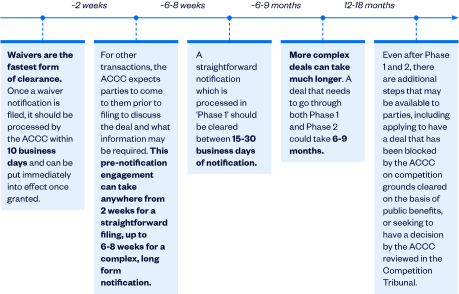
You also cannot complete or put a deal into effect until 15 days after the ACCC publishes its reasons in relation to the notification (although you can do so immediately if you get a waiver).
The cost
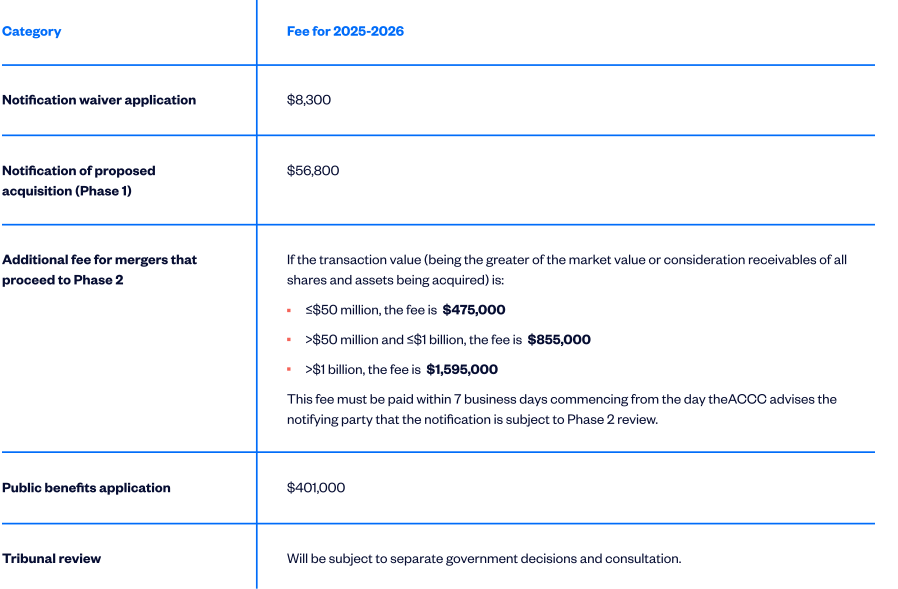
The filing fees are as follows:
Other factors
The ACCC is required to publish all notifications it receives on a public register, so the clearance process will be public.
Extension mechanism for ‘stale’ notifications
An ACCC decision to approve an acquisition becomes ‘stale’ after 12 months and the acquisition cannot be put into effect unless it is notified and approved again by the ACCC.
The ACCC may grant extensions of up to 6 months each, with no limit on the number of extensions that can be granted. In deciding whether to grant an extension, the ACCC must consider whether there are reasonable reasons why the acquisition has not been put into effect, whether there have been material changes to the market, and whether re-notification would be more appropriate.
Practical guidance – how to prepare for the new regime
The regime is new and complex and will continue to evolve over the coming months. However, here are some practical tips and recommendations for navigating the next 12 months or so:
 Err on the side of caution
If you are not sure, seek advice.
The consequences of not notifying a transaction are severe – it is voidable, i.e. it may be voided if the Court orders.
 Consider who are 'connected entities'
This will be important in determining whether an acquisition is notifiable, as well as having implications for what information needs to be included in any notification form.
 Remember that it applies to more than just M&A
The regime now extends to leases, project and concession agreements, and other commercial arrangements.
 Allow time for the ACCC
Assume a minimum of six to eight weeks for ACCC clearance, even for straightforward deals.
 Upfront information
The process now requires considerable up-front information about the parties, relevant markets, the deal itself as well as all transaction documents. You will also need to provide information about any other relevant acquisitions over the last 3 years.
 All notifiable transactions now need to have an ACCC condition precedent
A transaction can’t be completed until the ACCC gives the green light, so make sure timing, cooperation obligations and termination rights reflect this.
 Be aware that your deal will be public
The register will include general information about the deal, including the parties and the asset or entity being acquired.
 Check any non-competes or other restraints
The ACCC may reject non-competes in sale or related agreements, remember to have these reviewed before filing.
 Be careful not to ‘gun jump’
A deal cannot be implemented until ACCC clearance is complete – avoid any pre-completion integration steps.
Webinar: A practical guidance to the new Australian merger regime

Read our insights
International clients and firms
Cross‑jurisdictional deals involving Australian assets will now almost certainly require local clearance. While the reforms align broadly with global norms, they include unique thresholds and conditions that could capture transactions overlooked elsewhere.
At Gilbert + Tobin, we regularly act as Australian counsel to international firms, handling ACCC filings and coordinating with counsel in other jurisdictions.
Click on the thumbnail to download our full Merger Reforms in Australia brochure (PDF)

The Competitive Edge podcast series
Listen to the complete Competitive Edge podcast series here.
How we can assist
Our team is widely recognised as the leading competition and regulatory practice in Australia, advising on the most complex competition law cases in Australia and globally. We take a multi-disciplinary approach, integrating law and economics, plus a deep understanding of your business, your industry and those who regulate it.
That’s why clients trust us to deliver advice that’s practical, commercially sharp and designed to move with the pace of your business – not slow it down.
Notification assessment and strategy
We determine filing obligations and advise on deal structure to manage risk.
Lodging and negotiating ACCC clearances
From initial submission through to Phase 1 or Phase 2, we engage with the ACCC on your behalf.
Transaction structuring
We integrate ACCC risk into deal documentation, structuring conditions, timing and synergies.
Cross‑jurisdiction coordination
We partner with global firms to synchronise Australian and international merger clearance.
Proactive regulatory insight
We monitor regulatory developments, consult on draft guidelines and translate changes into client strategy.
Appeals
We act in Tribunal and judicial reviews, advising on appeals of ACCC decisions including appeal strategy, preparation of evidence for appeals and representation in appeals.