Gilbert + Tobin acknowledges the traditional owners and custodians of the lands on which it operates, the Gadigal peoples (Sydney), the Wurundjeri peoples of the Kulin Nation (Melbourne) and the Whadjuk Noongar peoples (Perth). G+T pays respect to Elders past and present. G+T also acknowledges the continued spiritual and physical connection of the Gadigal, Wurundjeri and Whadjuk Noongar to their lands and waters, known as Country.
1. A message from Gilbert + Tobin’s CEO on behalf of the G+T reporting entities
We are proud to present Gilbert + Tobin’s sixth annual Modern Slavery Statement in accordance with the Modern Slavery Act 2018 (Cth). Gilbert + Tobin is committed to working toward a world that is free from modern slavery and in which human rights are universally respected.
This year, after concluding and assessing the results of our earlier pilot of the Freedom Hub’s Risk Analysis and Measurement Platform (RAMP), we commenced a structured process to evaluate different tools available in the market for assessing supply chain risk and undertook a detailed review of procurement processes and procedures.
Sam Nickless (December, 2025)
CEO, Partner and member of the Gilbert + Tobin Board
Signed on behalf of all reporting entities
This Modern Slavery Statement was approved by the Gilbert + Tobin
Board in December, 2025.
2. Overview
Modern slavery is a practice known by various terms including forced labour, forced or servile marriage, debt bondage, forced commercial sexual exploitation, human trafficking, slavery-like practices, and the sale and exploitation of children. Regardless of the form it takes, these practices are characterised by the systematic removal of an individual’s freedoms to enable exploitation for personal or commercial gain. The problem is widespread and not improving. The most recent Global Estimates of Modern Slavery Report [1] indicates there are 50 million humans living in conditions of modern slavery globally. The Global Slavery Index of 2023 [2], estimates 41,000 people live in modern slavery in Australia.
Reducing the risk of modern slavery in our operations and supply chains remains an ongoing process. While we did not identify any instances of modern slavery in our operations or supply chains, we are continuing to focus on improving our modern slavery risk management framework. We refreshed our procurement policy and procedures, developed requirements for and investigated modern slavery assessment tools and tested an assessment process of meeting with the management of high-risk suppliers.
Reporting Entities
Gilbert + Tobin is an Australian partnership. This Modern Slavery Statement is made in compliance with section 14 of the Modern Slavery Act 2018 (Cth) (the Act) on behalf of the partnership of D.T Gilbert & S Nickless & W.R Spain trading as Gilbert + Tobin (ABN 88 775 098 848) and G&T Service Company Pty Ltd as trustee for G&T Service Trust (ABN 77 458 970 098), an associate entity of Gilbert + Tobin (G&T Service Company).
These reporting entities are referred to collectively in this statement as ‘G+T’ (‘we’ / ‘us’ / ‘our’). This statement has been prepared by Gilbert + Tobin in consultation with G&T Service Company and covers the period 1 July 2024 to 30 June 2025.
[1] Global Estimates of Modern Slavery: Forced Labour and Forced Marriage, International Labour Organization, Walk Free and the International Organization for Migration, September 2022.
[2] Global Slavery Index, 2023, Walk Free.Organization for Migration, September 2022.
Associated entities
Gilbert + Tobin oversees the associated entities set out in Table 1. G&T Service Company is the only reporting entity in this group.
The other associated entities have voluntarily adopted this Modern Slavery Statement.
Table 1 List of Gilbert + Tobin’s associated entities
Entity name | ||
G&T Service Company Pty Ltd as trustee for G&T Service Trust | ABN 77 458 970 098 | |
G&T Premises Pty Limited | ABN 64 091 984 922 | |
G&T Consultants Pty Ltd | ABN 46 068 298 448 | |
G&T Professional Service Company Pty Ltd as trustee for G&T Professional Service Unit Trust | ABN 96 431 953 017 | |
G&T Foundation Pty Ltd as trustee for Gilbert and Tobin Foundation | ABN 96 679 503 419 | |
G&T LegalTech Solutions Pty Limited as trustee for G&T LegalTech Solutions Unit Trust | ABN 64 876 640 692 | |
G&T Tax Services Pty Limited as the trustee for G&T Tax Agent Unit Trust | ABN 95 332 013 597 | |
G&T Capital Services Pty Ltd | ACN 649 676 111 |
3. Our structure, operations and supply chain
3.1 About us
Gilbert + Tobin is an independent Australian law firm, with 1,073 partners and employees in its partnership and associated entities. The firm was founded in 1988 by Danny Gilbert and Tony Tobin as a small team of lawyers focused on providing excellent legal advice on high-profile, complex matters.
Gilbert + Tobin has had outstanding success since those early days. We are now recognised as a leading transaction, regulatory and disputes law firm. We handle some of the most complex transactions in Australia, advising acquirers, targets and financiers. We are trusted by clients on sensitive regulatory investigations and approvals, litigation and Royal Commissions.
Gilbert + Tobin provides legal services to corporations, governments, non-profits and other organisations on their most challenging issues. Our practice groups during the year were organised as Disputes and Investigations; Corporate Advisory; Consumer, Competition and Market Regulation; Banking and Finance; Technology and Digital; Energy and Infrastructure; Intellectual Property; and Real Estate. In addition to legal services, we also provide consulting services to clients on inhouse legal operations and technology, through our G+T Innovate team.
Gilbert + Tobin has been committed to improving the human rights of all since the founding of the firm. Since inception, pro bono work has been a vital part of who we are, what we stand for and what we do. The firm’s pro bono legal practice has a proud track record and human rights is one of the core focus areas of the practice group. Our commitment to pro bono legal services was informed by the strong view of the founding partners that legal services have responsibilities to the community to help ensure that our legal system is fair and accessible to all, and this view is shared firmwide. We maintain a strong commitment to the provision of pro bono services to disadvantaged people and not-for-profit organisations and focus on reconciliation with Australia’s Indigenous peoples.
3.2 Our operations
Gilbert + Tobin is an unincorporated partnership of 112 partners and provides legal services. We operate in Australia only, through three offices located in Sydney, Melbourne and Perth. We do not have any international locations; however, we regularly advise international clients and work closely with leading overseas law firms to support our clients.
The Gilbert + Tobin partnership and its associated entities are governed by a board selected from among the partners of Gilbert + Tobin. Each associated entity, including G&T Service Company, has its own board of directors, under the oversight of the Gilbert + Tobin Board.
D.T Gilbert & S Nickless & W.R Spain trading as Gilbert + Tobin (Gilbert + Tobin partnership) employs all the firm’s admitted legal practitioner staff.
G&T Service Company provides operational services to support the partnership and employs most of the firm’s operational staff. G&T Service Company delivers its services, in part, through an outsourced arrangement with Elevate Services Limited, who provides services from a dedicated service centre based in India . The size of the team in India engaged through the G&T Service Company has been reduced during the year.
Table 2 Number of staff employed by each Gilbert + Tobin entity
Employing entity | Number of G+T employees | |
D.T Gilbert & S Nickless & W.R Spain trading as Gilbert + Tobin | 538 | |
G&T Service Company Pty Ltd as trustee for G&T Service Trust | 324 |
3.3 Our impact
Gilbert + Tobin makes a strong contribution to the Australian economy, with over 1,000 full-time, part-time and casual employees as at 30 June 2025. This includes an intake of 38 graduates this year.
Gilbert + Tobin’s strategic ambition is ‘to be Australia’s leading transactions, regulatory and disputes firm, committed to outstanding corporate citizenship’.
Our lawyers are members of the Law Societies of NSW, Victoria and Western Australia. Our firm is also a member of other associations including the Business Council of Australia, Business Council for Sustainable Development Australia and Australian Legal Sector Alliance. G&T Tax Services Pty Limited is a registered tax agent under the Tax Agents Services Act 2009 (Cth).
We are committed to outstanding citizenship. Our pro bono legal services have a proud track record, and we champion important causes, such as marriage equality and reconciliation with Aboriginal and Torres Strait Islander peoples. We value diversity, equity and inclusion and have one of the highest proportions of women partners among major Australian law firms.
Gilbert + Tobin continues to be committed to helping our clients respond to their Environmental, Social and Governance (ESG) risks. Gilbert + Tobin’s Climate and Sustainability practice continues to work with clients across all sectors to understand their ESG issues, support their ESG strategies, and manage regulatory compliance risks. As Australia’s leading transactional firm , we have also seen the increasing importance that ESG plays in guiding investment decisions. Our team brings the same rigour we apply to all other investment due diligence to ESG due diligence. We work with our clients to frame appropriate scopes of work for transactions due diligence which addresses not only regulatory compliance, but also considers business approaches to ESG governance, policies and procedures and climate and ESG strategy. This enables key ESG risks and opportunities to be identified and taken into consideration in transaction decision-making, structuring, risk allocation and pricing, and enabling our clients to develop clear pathways for mitigation of identified risks. Our due diligence services also extend to human rights and sustainability due diligence for businesses and their supply chains, including applying and putting the UN Guiding Principles on Business and Human Rights into practice.
3.4 Our supply chain
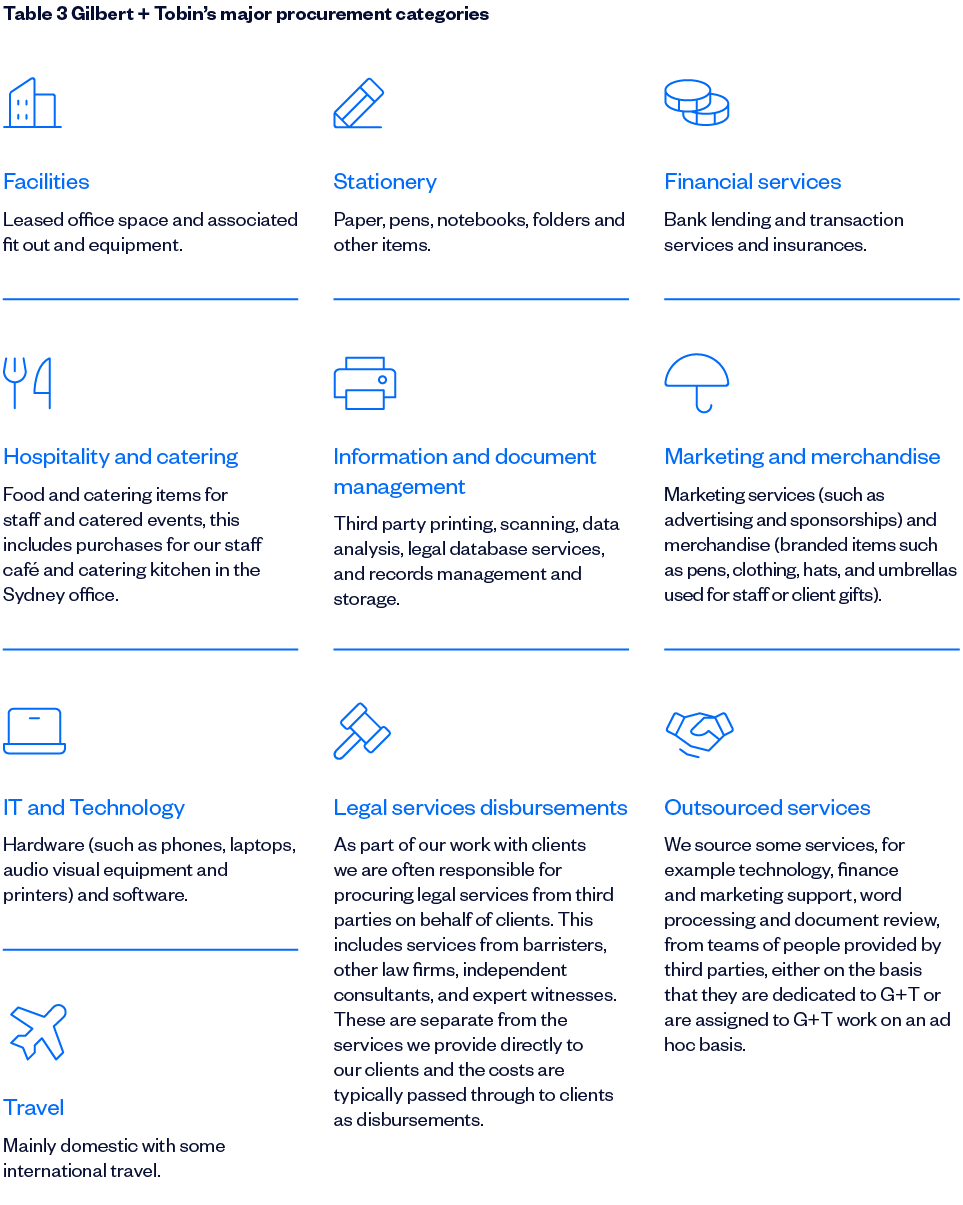
Gilbert + Tobin mainly procures goods and services from suppliers based in Australia. Our major procurement categories are set out in Table 3. We note there have been no major changes to our supply chain since last year.
Excluding legal services disbursements, this year Gilbert + Tobin used over 800 suppliers and approximately 87% of spend was with a core group of 100 suppliers.
4. Our modern slavery risks
Gilbert + Tobin did not identify any specific instances of modern slavery harm this year. However, we have identified several areas within our operations and supply chain where risk factors for modern slavery exist.
These risk areas were informed by a modern slavery risk review conducted in FY2025, using desktop review of modern slavery data and due diligence related documentation. The assessment of firm risks was overseen by Gilbert + Tobin’s Risk Committee. This committee comprises the accountable heads of operational functions (technology, HR, marketing, services, finance), representative partners of the firm, the Chairman, Chief Executive Officer, Chief Risk Officer, and General Counsel, and reports to the Gilbert + Tobin Board.
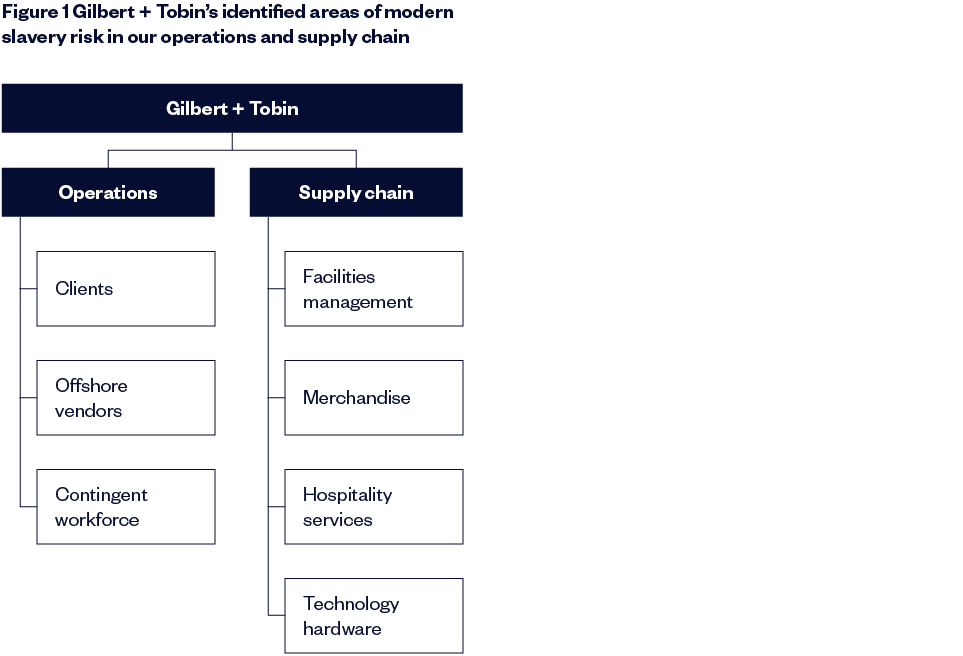
We conducted a risk-based analysis of our expenditure to identify areas of modern slavery risk. The process involved assessing the modern slavery risks of the firm’s top 113 suppliers (by spend) based on the type of product or service provided, the geography of supply, and any known supplier-specific issues. This assessment identified the areas of risk as set out in Figure 1 (below).
We had previously assessed that the risk of all forms of modern slavery has been heightened in recent years by compounding crises including the COVID-19 pandemic , armed conflicts and climate change, resulting in serious disruption to employment and education, increases in extreme poverty and forced and unsafe migration, and an increase in reports of gender-based violence (Global Estimates of Modern Slavery Report) [2] and consider the risk remains heightened.
Gilbert + Tobin continued to use the Global Slavery Index and Global Estimates of Modern Slavery Report to identify countries of higher risk and sectors of higher risk within those countries.
4.1 Operations
Clients
Gilbert + Tobin’s core business is the provision of legal services to clients. If clients are engaged in or associated with modern slavery in their operations or supply chains, Gilbert + Tobin might be unintentionally linked to such practices through the provision of our legal services to the client.
Offshore vendors
Gilbert + Tobin has service agreements in place with two offshore vendors that provide technology, finance and marketing support, document review, and word processing services. These vendors are based in India and South Africa. Gilbert + Tobin has identified that the countries in which these suppliers operate have a higher risk of potential modern slavery based on the presence of factors including political instability, poverty, the displacement of people due to conflict and climate change and discrimination on the basis of gender, race, caste and ethnicity (Global Slavery Index).
Contingent workforce
Our arrangements with offshore vendors facilitate contingent workforce requirements to meet service demands.
4.2 Supply chain
Most of our suppliers are Australian based. However, many of these suppliers themselves source goods or services from overseas. Some of these are from locations that may be more at risk of modern slavery. We recognise that the risks may be removed from the party with which we have contracted at the second or third tier of the supply chain.
4.3 Facilities management
Our expenditure on facilities is significant. Given the nature of some of the services provided, it presents some of the most important modern slavery risks. Cleaning services are recognised as key risk sector for modern slavery in Australia. The industry is particularly susceptible to the exploitation of workers largely due to:
the demographic vulnerability of the workers commonly employed as cleaners, many of whom may be on temporary visa; and
the complex employment chains and contracting arrangements (often in multiple tiers) which may obscure labour conditions.
Similar risks exist in other facilities services, such as maintenance contracts for plants and office equipment, as well as couriers.
4.4 Outsourced teams
Where third parties are providing the services of individuals to us under an outsourced arrangement, there is a risk of modern slavery issues with the employment of those individuals. This risk is heightened where the supply is from overseas, outside our immediate physical presence, and from countries where there are higher risk factors.
4.5 Merchandise
Our marketing function involves the purchase of branded goods, including stationery items, clothing and other giftware. These types of products can be higher risk because of the nature of their manufacture, including mass production at low cost in countries that may have a higher risk of modern slavery.
4.6 Technology hardware
Electronic goods such as computers, telephones, printers, screens, cables and other peripheral devices pose risks of modern slavery because of their complex and global supply chains. This applies to the sourcing of raw materials and the manufacturing and logistics processes along the supply chain.
4.7 Hospitality services
Due to the nature of the work involved in the production, processing, packaging and transport of food and produce, these supply chains have an elevated risk of modern slavery. In Australia, forced labour predominantly occurs in high-risk industries reliant on migrant workers who enter Australia on temporary visas including agriculture, construction, domestic work, meat processing, cleaning, hospitality and food services (Global Slavery Index).
5. Our actions to assess and address modern slavery risks in FY2025
This section sets out the actions we have taken to assess and address modern slavery risks in our operations and supply chain this year.
5.1 Resourcing our modern slavery commitments
Our Compliance, Legal and Risk (CLeaR) team , headed jointly by the our General Counsel and Chief Risk Officer, worked closely with our Corporate Social Responsibility (CSR) team to implement the firm’s modern slavery approach.
Gilbert + Tobin’s risks were overseen by Gilbert + Tobin’s Risk Committee. This committee comprises the accountable heads of operational functions (technology, human resources, marketing and business development, procurement, finance), representative partners of the firm, the Chairman, Chief Executive Officer (CEO), Chief Risk Officer (CRO), and General Counsel (GC).
This year, after concluding and assessing the results of our earlier pilot of the Freedom Hub’s Risk Analysis and Measurement Platform (RAMP), we commenced a structured process to eveluate different tools available in the market for assessing supply chain risk and undertook a detailed review of procurement processes and procedures.
5.2 Supplier rationalisation and onshoring supplier onboarding process
Gilbert + Tobin has a decentralised approach to procurement with a significant number of staff authorised to make purchases, resulting in a large catalogue of small suppliers, which may increase the risks of modern slavery in our supply chain. During the year, we undertook a comprehensive review of our procurement policies and procedures.
A refreshed Procurement Policy and Procurement Procedure were considered and endorsed by our Risk Committee. The Procurement Policy was subsequently endorsed by the partnership of Gilbert + Tobin in accordance with our governance framework.
5.3 Due diligence: supply chain
Gilbert + Tobin has established processes for assessing and monitoring modern slavery risk in our supply chain. Our Procurement and Risk teams continue to operationalise our Supplier Modern Slavery due diligence program, as set out in previous modern slavery statements and enhanced under our revised procurement policy and procedures.
This year we issued the firm’s modern slavery questionnaire to the firm’s top 113 suppliers (by spend) using Gilbert + Tobin’s governance risk and compliance management platform, 6clicks. Where a supplier had already made public its own Modern Slavery Statement, we did not require that supplier complete our modern slavery questionnaire.
Of our top 113 suppliers, 69 had issued a Modern Slavery Statement, 37 responded to the Gilbert + Tobin questionnaire, and 4 did not respond.
We assessed the responses of the 37 suppliers who responded to the modern slavery questionnaire and no issues were identified.
The annual assessment of our top 113 suppliers (by spend) shows that we have obtained a 97% response compliance to Gilbert + Tobin expectations in regard to modern slavery practices from its suppliers. For top suppliers that neither responded to Gilbert + Tobin’s questionnaire nor made a Modern Slavery Statement available publicly, Gilbert + Tobin intends to review the terms of its agreement with the supplier and where possible consider sourcing an alternative provider who can meet the Firm’s expectations.
In relation to the areas of our supply chain identified as being of higher risk, the following due diligence was undertaken:
Hospitality services
G+T has 9 travel and catering suppliers in its top 113 suppliers (by spend). We have issued modern slavery questionnaires to 2 of these suppliers, both of which responded. The remaining suppliers have published modern slavery statements.
Technology hardware
Of our three key technology hardware suppliers, two suppliers completed our modern slavery questionnaire in FY2025, and no modern slavery risks were identified. One supplier did not complete the questionnaire but had a modern slavery statement which was reviewed, and which demonstrated that the supplier had systems in place to manage modern slavery risks.
Facilities management
Gilbert + Tobin has four key facilities suppliers – Jones Lang LaSalle (JLL) (NSW), Jones Lang LaSalle (VIC), CBRE and Brookfield. Jones, Lang LaSalle entities, CBRE and Brookfield have Modern Slavery Statements on their websites. We have reviewed their Modern Slavery Statements and confirmed that these suppliers have all implemented systems for managing modern risks within their business and supply chains.
5.4 Management controls
Facilities
Facilities are an area of heightened risk of modern slavery in Australia, given the nature of the sector (see section 4.3). Our offices are all housed within buildings that are owned and operated by top-tier landlords, from whom we source much of these services. We have strong and continuing engagement with our landlords on this issue to understand and address any such risks.
Outsourced teams
While this was an area that warranted attention, we assessed the risks of modern slavery in this situation as low, given the substantial, regular engagement that we have with the suppliers we use for these services, Elevate and Exigent (part of Morae Global). Both suppliers are reputable top-tier suppliers of these services, with both headquarters based in the US. Our agreements with them are subject to terms relating to working conditions and treatment of their staff and their Modern Slavery Statements are both publicly available. There were no complaints or disclosures through any channels, including our confidential whistle-blower platform Whispli, from Elevate and Exigent staff.
Senior managers from Gilbert + Tobin are responsible for interacting with and managing the Elevate and Exigent teams and know the outsourced staff and regularly meet with them on video and audio calls. These dedicated outsourced staff have access to Gilbert + Tobin communications in the same way as our Australian based staff. They have access to Gilbert + Tobin’s whistle-blower channels and protections and receive the same training and information on their availability.
The market for people with the skills of these staff is competitive, particularly in India. Turnover occurs on a regular basis as opportunities emerge, indicating free movement for these staff.
Further, based on business needs, during the year we replaced some of our IT services in India with Australian staff based in Australia, reducing the modern slavery risk profile for Gilbert + Tobin by moving those resources to a lower risk country.
Technology hardware
This is a difficult area of risk that almost all businesses will face. Gilbert + Tobin is a relatively small customer of the suppliers of this equipment. Addressing this risk will require coordinated, global actions from governments and all participants in the supply chain. For our part, we are focusing on ensuring our purchases are from top-tier reputable suppliers and engaging with those suppliers to better understand their supply chains and approaches to addressing the risks of modern slavery.
Merchandise
Over the past few years, we have focused on rationalising our suppliers for this type of purchase and ensuring that all procurement is done through a centralised marketing function. The greatest risk would be from individuals making their own purchases or orders from suppliers where the same level of inquiry would not have been completed.
The current approach requires all staff to only purchase such merchandise through an online portal with a single supplier, that has provided us with their Social Compliance Policy which assures us that they are compliant and monitor the modern slavery risks in their own supply chain. We recognise this part of our supply chain as having particular risk and will be monitoring suppliers’ compliance with our policy documents closely.
5.5 Enhancing capabilities
After completing the pilot of The Freedom Hub’s Risk Assessment and Management Platform (RAMP) last year, we reviewed the outcome of that pilot and subsequently developed requirements for a tool to assist us with modern slavery assessments. Stakeholders within Gilbert + Tobin have reviewed several tools available on the market and Gilbert + Tobin is in the process of selecting the tool that best meets its requirements and enhances our ability to make assessments about suppliers.
All key people responsible for procurement have been trained in making modern slavery assessments and have access to training materials on modern slavery in our G+T Academy.
We also piloted a process of interviewing management of a high-risk supplier in person to assist in validating our assessment of modern slavery risk for that supplier.
6. Assessment of effectiveness and our actions for the future
Gilbert + Tobin intends to focus on the following actions in the upcoming period.
6.1 Ongoing development of fundamental effectiveness
Gilbert + Tobin has established an effective base for assessing and managing modern slavery risks. As we have this year, we will continue to review our policies and procedures to ensure that we are effectively monitoring and assessing any risks in our operations and with our suppliers. This will involve ongoing consideration of stakeholder engagement with our policy documents and procedures. We will update these policies and procedures where appropriate following such review, in response to changes and developments relating to modern slavery risks more broadly, or changes in obligations. Next year we intend to undertake a review of our Supplier Code of Conduct.
6.2 Enterprise risk management
We will continue to work on an ongoing basis with Gilbert + Tobin’s Risk Committee to integrate the assessment and management of modern slavery risks across each area of the business, in line with Gilbert + Tobin’s Risk Management Framework.
6.3 Systems
Having now developed requirements for a tool to assist us with modern slavery assessments in the process of selecting the tool that best meets the requirements of Gilbert + Tobin, we intend to implement and refine the use of that tool to improve the effectiveness of supplier assessments.
6.4 Direct assessment
After testing the approach of interviewing management from higher risk suppliers to Gilbert + Tobin this year, we intend to conduct further first-hand assessments in the future.
7. Consultation
G&T Service Company was consulted in the preparation of this Modern Slavery Statement. Gilbert + Tobin’s CEO contributed to the development of this Modern Slavery Statement, is a director of G&T Service Company, engaged with the company’s senior leaders and notified the board of their entity requirements. The Board of G&T Service Company has approved this statement.
All Gilbert + Tobin’s other associated entities have been made aware of the Act’s requirements and their Boards have noted this statement.
8. Approval
This Modern Slavery Statement was approved by the board of the Gilbert + Tobin partnership on 20 November 2025 on behalf of Gilbert + Tobin and G&T Service Company. The Board of G&T Service Company then subsequently approved this Modern Slavery Statement for their operations.
Approved by G+T Board: 10 December 2025
Signed by
Name: Danny Gilbert
Title: Chairman of Gilbert + Tobin
Date: 18 December 2025
Name: Samuel Nickless
Title: Chief Executive Officer of Gilbert + Tobin and Director of G&T Service Company Pty Ltd
Date: 18 December 2025