Introduction
Aldi has a well-documented history of producing “mirror products”, which adopt similar names and packaging to those of competitors as a core element of its private-label strategy. It has historically defended challenges to that strategy under the Australian Consumer Law and the tort of passing off with some success. The Full Court of the Federal Court of Australia’s decision in Aldi Foods Pty Ltd v Hampden Holdings I.P. Pty Ltd [2026] FCAFC 103 shifts the legal ground to copyright infringement. The Full Federal Court (Burley, Moore and Owens JJ) found that Aldi’s MAMIA packaging infringed copyright in more of Hampden’s BELLIES packaging than found by the primary judge. In doing so, the Court clarified how courts should assess substantial reproduction when a competitor’s work has been emulated rather than copied outright.
The case concerned Hampden Holdings’ artistic works comprising the front-face packaging of its popular baby and child food products, sold under the Baby Bellies, Little Bellies and Mighty Bellies brands. The primary judge (Moshinsky J) found that Aldi instructed its design agency to “benchmark” the Bellies packaging and “follow the architecture”, with the aim of creating packaging that resembled Hampden’s, “albeit not too closely, because that would infringe the law”.
At first instance in [2024] FCA 1452, Moshinsky J found that the packaging of three Aldi puffs products reproduced a substantial part of Hampden’s works, but that the other non-puffs products were not similar enough. His Honour also found Aldi liable for additional damages. Aldi appealed the infringement findings and Hampden cross-appealed the findings of non-infringement.
The outcome was mixed for both parties. Aldi successfully established that the primary judge’s approach to assessing copyright infringement involved error. However, the Full Federal Court (Burley, Moore and Owens JJ) conducted its own assessment of the works and the practical result was worse for Aldi: liability for five infringing products rather than the three found at first instance. Importantly, the Full Court also upheld the finding of flagrant infringement, warranting additional damages under s 115(4) of the Copyright Act 1968 (Cth). This is likely to significantly increase the damages payable by Aldi at the forthcoming quantum hearing.
The Full Court’s approach
Aldi appealed the findings that its packaging infringed Hampden’s copyright, while Hampden cross-appealed the findings of non-infringement. The Full Court found that the primary judge had erred in two critical respects:
- First, by identifying design elements at a level of abstraction and treating them as either present or absent in a binary exercise, rather than undertaking a nuanced side-by-side comparison. The Full Court criticised the primary judge’s approach to ruling design elements wholly in or wholly out rather than undertaking a nuanced analysis of the extent of similarity. For example, the trial judge found that Aldi’s owl on the rice cakes packaging was not the Hampden character because it was “much larger”, so the figures played no further part in the analysis despite clear visual similarities, including the distinctive light-coloured belly with writing within.The Full Court held that the correct approach requires a detailed side-by-side comparison of the relevant pair of works and a qualitative assessment of the degree of similarity and differences between visual elements, to decide whether a substantial part of the work has been reproduced.
- Second, the primary judge failed to consider the evidence of the originality of the aspects found to be similar, including Mr Bowen’s evidence about the creative process. Drawing on the High Court’s reasoning in IceTV, the Full Court reiterated that originality is critical to the quality of what is taken.
The Full Court then reconsidered infringement itself, conducting its own side-by-side comparison of each pair of works.
Three products found to be infringing at first instance
Applying its own assessment, the Full Court independently confirmed infringement for the three Aldi Puffs Works found to infringe at first instance, but on a narrower basis: each Aldi Puffs Work infringed only its corresponding Hampden Puffs work.
Blueberry Puffs: Hampden Item 1 v Aldi Item 9
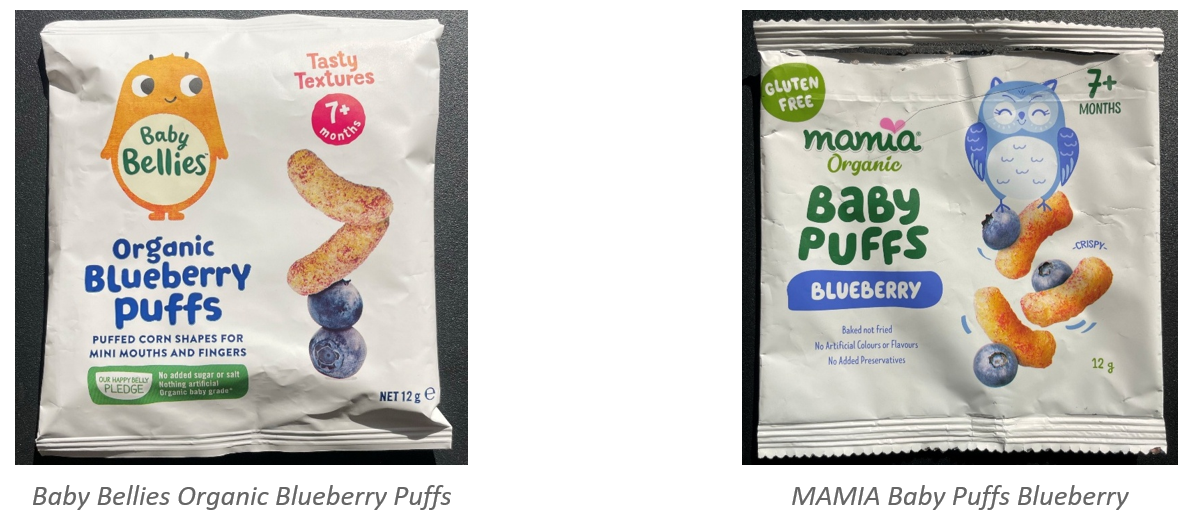
The Full Court found that Aldi’s MAMIA Baby Puffs Blueberry reproduced a substantial part of Hampden’s Baby Bellies Organic Blueberry Puffs, having regard to the totality of relevant elements in combination:
- photographs of blueberries and puffs were sufficiently similar to amount to a reproduction of that element
- the colour palette (orange, blue, green and pink in similar shades) was reproduced
- a distinctive child-like font was used for the product description
- a two-column layout, with product description on the left and photographs on the right
- the cartoon character (an owl in Aldi’s case) featured a distinctive off-white circular belly
- both works featured irregular rectangular boxes for supplementary text, a white background and an age indicator.
Evidence of originality from Mr Bowen (Creative Director of B&B Studio, the design agency engaged by Hampden to design the packaging) demonstrated creative effort in photography choices, font selection and colour palette. There was no evidence of anything in the market containing this particular combination of features.
Apple & Cinnamon Puffs: Hampden Item 6 v Aldi Item 10
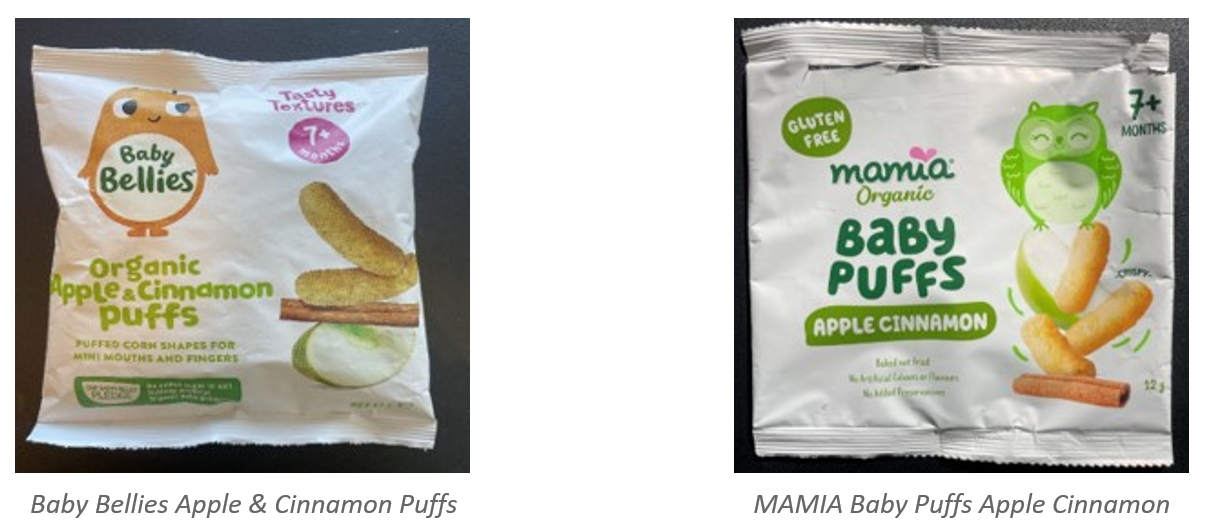
The Full Court’s analysis was very similar to the Blueberry Puffs pairing. Key similarities included:
- two-column layout with cartoon character featuring a distinctive belly
- child-like font for the product description
- colour palette with apple and cinnamon accents
- photographs of product and fruit; irregular rectangular boxes, white background and age indicator.
The differences (including colour accents reflecting the different flavouring) did not prevent the finding of substantial reproduction.
Organic Carrot Puffs: Hampden Item 7 v Aldi Item 11
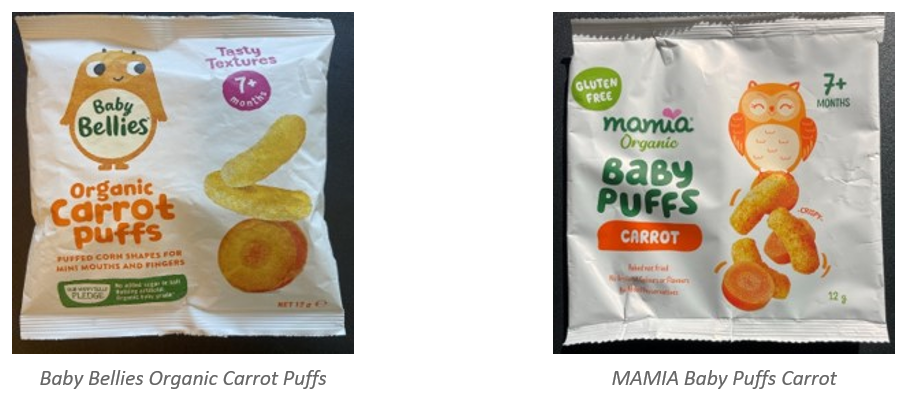
The Full Court’s analysis substantially mirrored the Blueberry and Apple Puffs pairings. The same combination of original elements was present:
- a two-column layout
- cartoon character with distinctive belly
- child-like font
- a similar colour palette
- photographs of product and carrot slices
- irregular rectangular boxes
- white background and age indicator.
The Full Court found that this combination amounted to a substantial part of Hampden’s work.
Two additional products found to infringe on appeal
On the cross-appeal, the Full Court overturned the primary judge’s findings of non-infringement in respect of two further Aldi products. These were described as “not easy or clear-cut” cases — they were borderline at first instance because they involved different product categories and packaging formats.
MAMIA Fruit & Oat Bars Apricot (Aldi Item 4) v Baby Bellies Blueberry Puffs (Hampden Item 1)
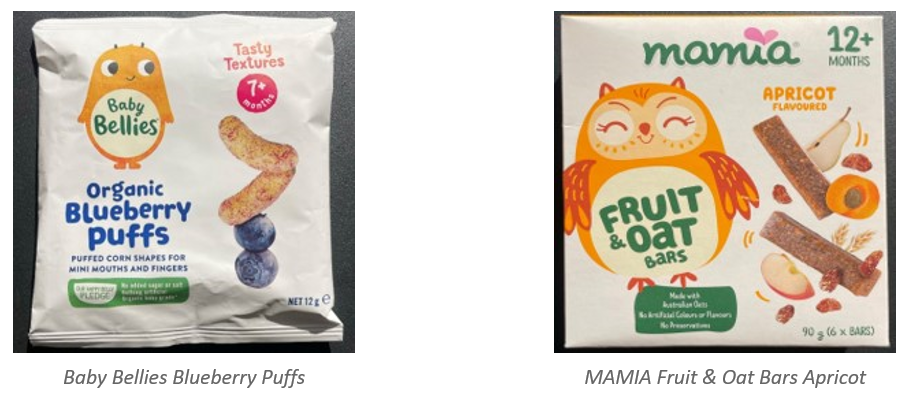
The Full Court found that Aldi’s Fruit & Oat Bars Apricot reproduced a substantial part of Hampden’s Blueberry Puffs, notwithstanding the different product type. Critical factors included:
- The cartoon character (although different) took the distinctive round, light-coloured belly with green writing — a “particularly distinctive” part of the Hampden work, with no evidence it was otherwise in the market. The Full Court acknowledged a significant difference that Hampden’s character had the brand name “Bellies” in the belly, reinforcing the brand visually, whereas Aldi’s character had the product descriptor. This reduced, but did not eliminate, the significance of the appropriation.
- Both characters were orange.
- A child-like font was used for the product description.
- Other similarities: green irregular rectangular box, dark green shade, general layout, white background, pink colouring at the top and age indicator.
The Court acknowledged differences — notably a box rather than a pouch, and a different product type — but concluded the common elements formed “(just) sufficient” of a substantial part to constitute infringement.
MAMIA Fruit Snack Cereal Bars (Aldi Item 6) v Baby Bellies Blueberry Puffs (Hampden Item 1)
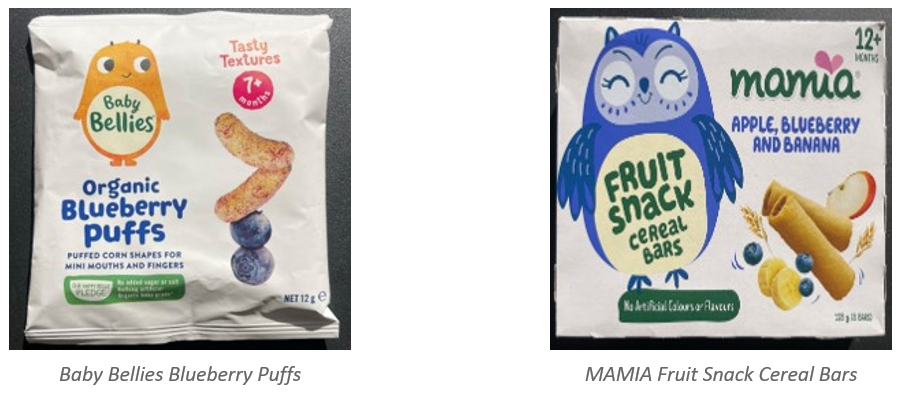
The Full Court’s analysis was similar to the Apricot Bars pairing. Key similarities included:
- The owl character reproduced the distinctive round, light-coloured belly with green writing.
- Photographs of blueberries; blue writing.
- A two-column layout.
The owl was blue rather than orange, but on balance the common elements were “(just) sufficient” to amount to a substantial part.
Non-infringing products
The Full Court dismissed the remainder of Hampden’s cross-appeal, upholding the primary judge’s findings of non-infringement for the following Aldi products.
MAMIA Rice Cakes Apple (Aldi Item 1) v Baby Bellies Blueberry Puffs (Hampden Item 1)
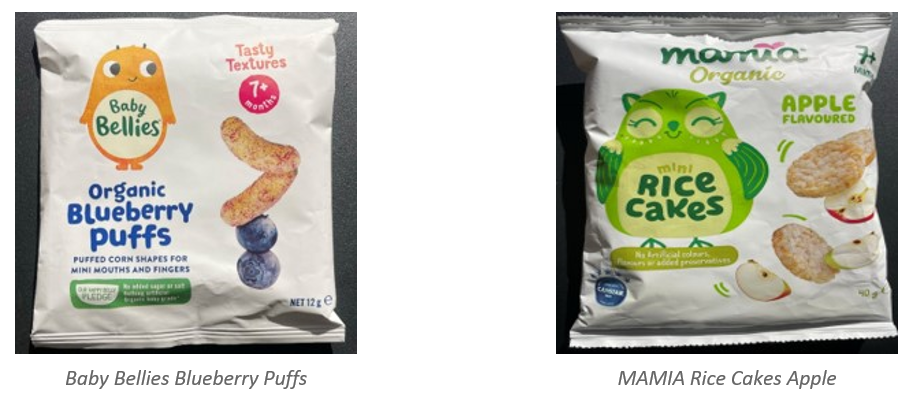
Critical distinguishing features:
- the green owl (not orange as in the Hampden work)
- green belly background
- absence of blueberries or blue elements
- materially different colour palette.
The overall impression lacked the combination of features that grounded infringement in other pairings.
MAMIA Fruit & Oat Bars Strawberry (Aldi Item 3)
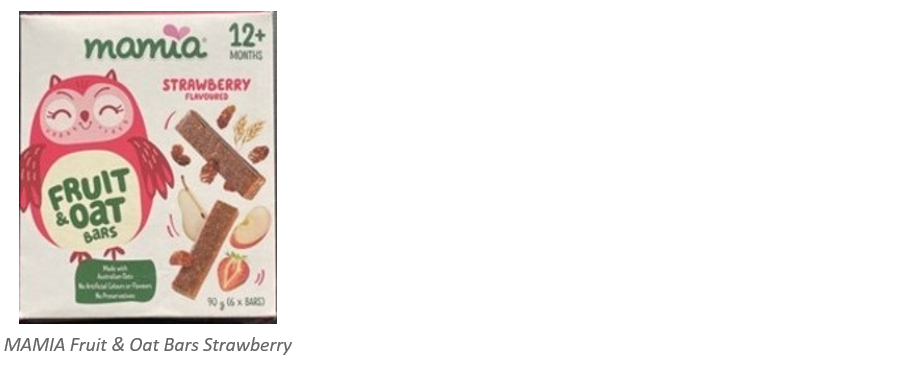
Key distinguishing features:
- the hot pink owl, rather than orange, was a significant distinguishing feature
- the orange owl was a material element in the infringement finding for the Apricot Bars (Aldi Item 4). The pink owl lacked that feature without any counterbalancing similarity.
Various MAMIA Products (Aldi Items 2, 5, 7 and 8)
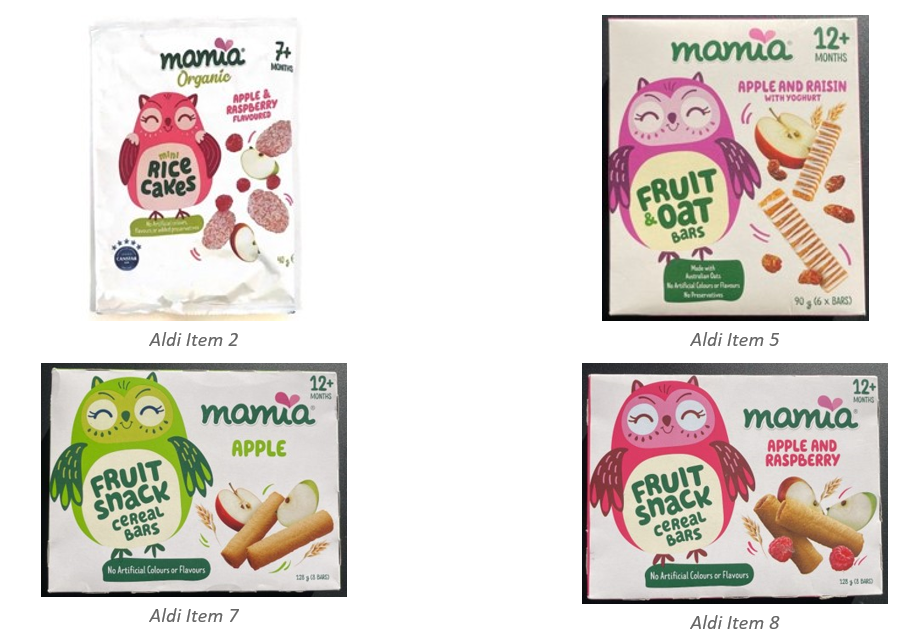
Different layouts, colour schemes and absent elements meant that the common features did not constitute a substantial part of any of Hampden’s works.
Key takeaways
This decision offers several practical lessons for brand owners and IP practitioners:
- Intent does not insulate from liability. Instructing designers to avoid getting “too close” to a competitor’s packaging does not prevent liability if the end result objectively reproduces a substantial part of the competitor’s work. The intent to stay within the law is irrelevant to the infringement finding and may actually support a finding of flagrant infringement warranting additional damages.
- Copyright protects form of expression, not look and feel. A general “look and feel” is not protectable. The focus is on specific forms of expression. Infringement must be assessed by comparing specific pairs of works, not by reference to a common design language. Brand owners should document the specific creative choices that make their packaging original.
- Enforcement strategy matters. The Full Court criticised Hampden’s approach of pursuing a generalised “look and feel” argument across multiple works and its failure to undertake side-by-side comparisons when invited to do so. When considering a copyright claim, brand owners should identify the specific pair of works for comparison and articulate precisely which visual elements have been reproduced and why they are original. A diffuse infringement case spread across multiple alternative claims is unlikely to be effective.
- Evidence of originality matters. Evidence of the skill and labour invested in creating a copyright work assists in establishing originality, which is critical to the substantial part assessment. Brand owners should retain detailed records of the design process.
- Cosmetic changes do not immunise. Changes to an appropriated work do not necessarily prevent a finding of infringement. Dissimilarities may be characterised as deliberate attempts to obscure appropriation, particularly where there is evidence of copying.
- The totality of elements matters. Reproduction of relevant elements in combination is central to the substantial part assessment. Individual elements may be commonplace; their particular combination may not be.
- Flagrant infringement attracts additional damages. Deliberately developing packaging to resemble a competitor’s, even with an intention to stay within the law, constitutes “courting a risk” that may be characterised as flagrant infringement warranting additional damages. The safest course is to undertake an independent design process without reference to competitor products.