The energy transition is often framed as a shift away from traditional energy sources towards renewables. But in practice, the transition is proving more complex.
Across the Asia-Pacific region, energy demand continues to grow as economies industrialise, populations expand and governments pursue increasingly ambitious decarbonisation targets. At the same time, intermittent renewable generation cannot yet deliver the scale and reliability required to support modern energy systems without firming, storage and dispatchable generation.
That is where liquid natural gas (LNG) remains important. Rather than simply acting as a temporary bridge, LNG can support countries seeking to balance affordability, grid reliability, industrial growth and emissions reduction simultaneously.
When paired with carbon capture and storage (CCS), that role could become even more significant. CCS has the potential to transform LNG from what is often perceived as a transitional commodity into a long-term component of a decarbonised energy system.

Key takeaways
- LNG remains a critical source of reliable energy as economies pursue decarbonisation while managing energy security and affordability.
- CCS could materially improve the long-term emissions profile and investment case for LNG projects.
- Australia’s LNG infrastructure, proximity to key demand centres and geological storage capacity create a distinctive competitive advantage.
- Cross-border carbon transport and storage could become a significant new industry alongside LNG exports.
- Policy settings will be critical to encouraging long-term investment in LNG and CCS projects.
LNG’s role is being misunderstood
LNG is often described as a transitional fuel, acting as a bridge between higher-emitting energy sources and a future global energy system dominated by renewables.
That framing risks understating the strategic importance of LNG.
For many economies, particularly in Asia, the immediate challenge is not simply decarbonisation. It is decarbonisation while maintaining reliable, affordable and secure energy supply.
Until long-duration energy storage becomes commercially viable at scale, gas-fired generation remains one of the few realistic options available to complement intermittent renewable generation, support baseload power and stabilise grids.
In that context, LNG is not just a temporary bridge. It is an enabling energy source that allows countries to diversify their generation mix while managing industrial growth and emissions reduction at the same time.
CCS changes the investment thesis
The long-term challenge for LNG is emissions intensity.
Without CCS, LNG projects face increasing regulatory pressure, activist opposition and social licence challenges. Over time, this creates a risk that projects may be viewed as declining or transitional assets within increasingly carbon-constrained markets.
CCS changes that equation.
By integrating CCS into LNG developments, producers can offer lower-carbon molecules with lifecycle emissions profiles that are more capable of standing up under any credible decarbonisation framework.
In simple terms, CCS transforms LNG from what many incorrectly perceive as a declining transitional commodity into a long-term component of a decarbonised energy system.
That shift matters for investors, developers and policymakers. It reframes LNG not as a concession to fossil fuel incumbency, but as part of a pragmatic and scalable pathway for decarbonisation, particularly in markets where energy demand continues to grow.
Australia’s competitive advantage
Australia is well positioned to lead the world in this next phase for LNG.
The first advantage is geography. Australia is close to major centres of long-term LNG demand, including Japan, Korea, China and Southeast Asia. That proximity supports lower shipping costs, lower transport emissions and more secure supply chains.
The second is infrastructure. Australia already has substantial LNG infrastructure in place. Existing capacity, combined with brownfield expansion opportunities, means additional supply can come online with lower execution risk and shorter lead times than entirely new greenfield projects.
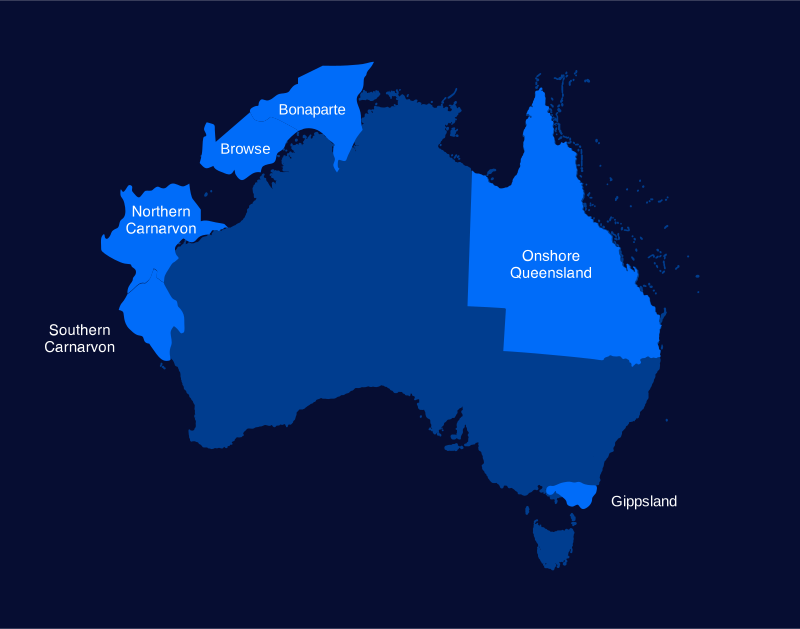
The third is geological storage capacity.Australia has significant CCS potential across basins including Browse, Carnarvon, Bonaparte and Gippsland, as well as onshore Queensland. That storage capacity could support emissions abatement over the full productive life of LNG projects.
Together, these advantages position Australia to become a supplier of genuinely verified low-carbon LNG at scale.
From LNG exports to carbon management
The opportunity extends beyond LNG supply.
Many Asian economies do not have sufficient domestic geological storage capacity to decarbonise heavy industry at scale. Australia does.
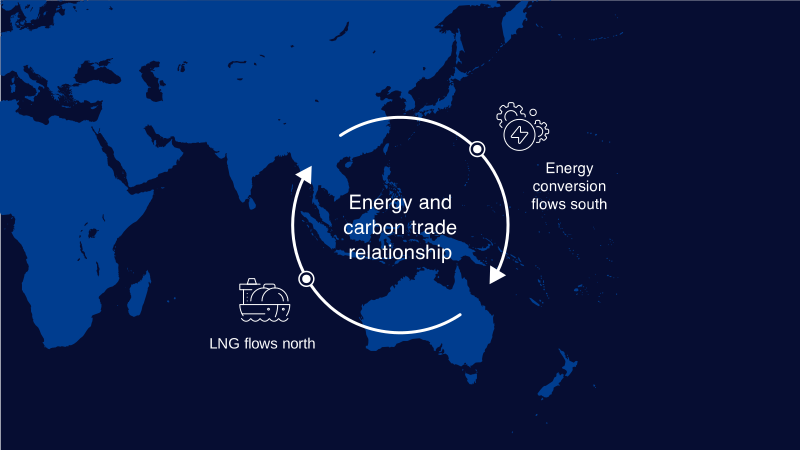
That creates the possibility of a circular energy and carbon trade relationship: LNG flows north into Asia, while captured CO₂ from energy conversion flows south into Australian storage reservoirs.
Once that happens, the relationship stops being merely a commodity sale and purchase transaction. It becomes an integrated decarbonisation partnership.
For Australia, that could be economically significant. It would create opportunities across carbon transport, sequestration services, subsurface engineering and long-term emissions management,areas where Australia already has deep expertise through the LNG sector.
Policy settings will matter
Realising this opportunity will require policy settings that support long-term investment.
From a policy perspective, the focus should be on encouraging investment into LNG and CCS projects, rather than implementing settings that discourage capital deployment into sectors that will remain essential for decades.
This is not only a question for the Australian Government. Governments in high-emitting countries that benefit from associated emissions reductions and LNG supply also have a role to play.
Given the costs associated with CCS and their impact on investment returns, government support is likely to be important. Similar support has already been provided in other areas of strategic significance, including critical minerals and major CCS projects such as Norway’s Northern Lights project.
A strong case can be made for comparable support for LNG and CCS. If implemented effectively, it could stimulate economic activity, increase gas available for domestic consumption and support decarbonisation efforts across the Asia-Pacific region.
What this means
The debate around LNG is often framed as a choice between traditional carbon-based energy sources and the transition to renewables.
That framing is too narrow.
LNG paired with CCS offers a different pathway. One that recognises the realities of energy demand growth, grid reliability, industrial development and emissions reduction.
For Australia, the opportunity is significant. The country has the resources, infrastructure, expertise and geological storage capacity to shape the next phase of LNG’s role in the energy transition.
The next chapter for LNG may not be defined by fuel exports alone. It may be defined by Australia’s ability to combine energy production and carbon management into a scalable decarbonisation solution.
Watch: the next chapter for LNG
Mark McAleer discusses how LNG and CCS could reshape Australia’s energy advantage and support decarbonisation across the Asia-Pacific region.