The 30th session of the United Nations Conference of the Parties (COP30) concluded in Belém, Brazil, in the evening of 23 November 2025, after two weeks of intense international climate negotiations. COP30 ended with a suite of decisions that saw some key areas which had been politically stalled in previous years, move forward with agreed work programmes. However, consensus on flagship issues relating to ambition, finance and transitioning away from fossil fuels remained out of reach.
COP30 President André Corrêa do Lago stated that COP30 must be remembered as the ‘COP of implementation and adaptation’ and ‘COP of truth’. As part of these efforts, COP30 was framed by the Brazilian Presidency as a global ‘mutirão’ – a Portuguese word with Indigenous roots – meaning ‘collective effort’. That spirit was evident around the venue on a range of topics, despite the fact that negotiations on substantive issues were highly contested.
The Presidency identified Brazil’s key priorities for COP30 to:
Shift pledges to implementation, with a strong emphasis implementing the outcomes of the first Global Stocktake (GST) from 2023 and just transition work programme in a way that promote transparency, justice, and practical solutions.
Scale climate finance by delivering the Baku-to-Belém Roadmap to detail how to scale climate financing up to the new collective quantified goal on climate finance (NCQG) agreed at COP29.
Advance the Baku Adaptation Roadmap (BAR) and reach a final decision on the indicators of adaptation used to measure progress towards the GGA.
Strengthen climate multilateralism, governance and global cooperation.
COP30 made progress across several priority areas, but significantly more ambition and finance will be needed to keep the Paris Agreement goals within reach. Below we outline the key outcomes from COP30, identifying areas of progress, areas for further discussion in 2026 and key takeaways for the private sector.
Snapshot of COP30 outcomes
Presidency’s “Big 4” negotiation issues: The Presidency undertook consultations on four key issues that were outside the formal negotiations agenda, covering nationally determined contributions (NDCs) and ambition; the treatment of finance under Article 9.1 (developed country finance to developing countries); Biennial Transparency Reports (BTRs) and transparency, and climate-related trade measures, including unilateral trade measures (UTMs). These issues were addressed in the cover decision from COP30 (Mutirão Decision). These outcomes were contentious and left no Party wholly satisfied with the outcomes. In addition, non-government actors have raised concerns about the level of ambition demonstrated.
Climate finance: Climate finance was central to COP30 discussions, with a focus on how to deliver the NCQG and 1.3T Baku to Belém Roadmap. Intense discussions occurred on the obligations of developed country parties to deliver finance to developing countries. Adaptation finance was also a prominent issue, with Parties eventually agreeing to triple adaptation finance by 2035 after resistance from developed countries.
Carbon markets: COP30 decisions on Article 6 resolved administrative uncertainties, including funding constraints for the Article 6.4 mechanism and the closure of the Clean Development Mechanism (CDM). Parties affirmed the crediting standards and methodologies developed by the Article 6.4 Supervisory Body and reinforced the existing rulebook (which will be reviewed in 2028).
Mitigation: In response to UNFCCC findings that current NDCs fall short of a 1.5°C pathway, Parties decided to develop the Global Implementation Accelerator and the Belém Mission to 1.5°C under the Mutirão Decision. Parties also acknowledged that the global transition towards low-emissions, climate-resilient development is “irreversible and the trend of the future”. The Sharm el-Sheikh Mitigation Ambition and Implementation Work Programme (MWP) saw modest progress, with the MWP decision noting mitigation opportunities in forestry and waste sectors. Outside the negotiations, Australia and 23 countries joined the Belém Declaration on the Transition Away from Fossil Fuels, co-led by Colombia and the Netherlands.
Adaptation: Adaptation gained prominence at COP30 with agreement on the Belém Adaptation Indicators to track progress towards the Global Goal on Adaptation (GGA). However, these indicators are voluntary and do not create legal obligations. Given that several Parties from Latin America raised objections with the GGA text after it was adopted in the closing plenary, we expect the GGA decision and the indicators to be re-litigated over the next few years. Parties also launched a two‑year work programme to operationalise these indicators.
Just transition: Parties agreed to develop a Just Transition Mechanism that centres people and equity, aiming to enhance international cooperation, technical assistance, capacity‑building and knowledge‑sharing. Trade tensions were addressed in the Mutirão Decision, which reaffirmed open, non‑restrictive trade and mandated two years of subsidiary‑body dialogues (with World Trade Organisation participation) on how trade measures interface with climate action.
Transparency: COP30 acknowledged the first wave of BTR submissions and the learning curve for Parties. The Mutirão Decision recognised the need for timely and predictable support for developing countries to implement the Enhanced Transparency Framework.
Climate and biodiversity: The MWP decision highlighted findings and mitigation opportunities identified in a series of global dialogues carried out during the year in relation to forestry and waste sectors. The Mutirão Decision also promotes the importance of conserving, protecting and restoring nature and ecosystems towards achieving the Paris Agreement temperature goal. Outside of formal negotiations the Presidency signalled a desire to develop a roadmap targeted at halting and reversing deforestation. The Presidency also launched the Tropical Forest Forever Facility (TFFF) at COP30, which received USD5.5 billion in backing from governments around the world.
After three years of negotiations between Türkiye and Australia, it has been confirmed that Türkiye will host COP31 in Antalya and Australia will be delegated the responsibility for leading negotiations during COP31.
Key agenda items at COP30
Prior to COP30, several of Parties proposed new agenda items to reflect regional priorities. To avoid a dispute on inclusion in the formal agenda, the Presidency agreed to undertake consultations across four key items:
Responding to the synthesis report on nationally determined contributions and addressing the 1.5°C ambition and implementation gap.
Implementation of Article 9.1 of the Paris Agreement (in relation to the provision of climate finance from developed countries to developing countries).
Reporting and review pursuant to Article 13 of the Paris Agreement and BTRs.
Promoting international cooperation and addressing the concerns with climate change related trade-restrictive unilateral measures such as UTMs.
The Mutirão Decision addressed these four issues (among others). Where mandated items were linked to the issues canvassed under the Mutirão Decision, they were included as part of the ‘Belém Political Package’ and the Presidency took the pen on these documents.
On NDCs and ambition, negotiations centred around the gap between implementation and the 1.5°C temperature goal. The pace and pathway for transitioning away from fossil fuels rose to prominence.
In this respect, the Mutirão Decision:
Calls on all actors to work together to rapidly accelerate and scale up global climate action, enhancing cooperation and implementation this decade to keep 1.5°C within reach, build resilience and mobilize finance, technology and capacity-building, in accordance with the principles and provisions of the Paris Agreement.
Notes the importance of aligning nationally determined contributions with long-term low-emission development strategies and encourages Parties to align their contributions with net-zero pathways by or around mid-century to keep the 1.5°C goal within reach.
Parties also agreed to develop and establish two cooperative initiatives designed to close the implementation gap:
Global Implementation Accelerator: a mechanism to close the gap on implementation and the 1.5°C pathway by supporting Parties to implement their NDCs and NAPs. Expressly anchored in the GST Decision, this mechanism is expected to become the principal venue where concerns around the fossil fuel transition and sectoral pathways are voiced in formal circles over the coming years.
Belém Mission to 1.5°C: a platform to foster higher ambition across mitigation, adaptation and investment.
On finance, the Mutirão Decision establishes a two-year work programme on climate finance, including Article 9.1 obligations. Parties also agreed to convene a high-level ministerial roundtable to assess progress in implementing the NCQG.
These initiatives will advance negotiations on NCQG implementation by providing a political follow-up mechanism to boost ambition on climate finance. They also give developing countries a platform to press for the core US$300 billion in public finance and to mobilise private capital toward the US$1.3 trillion goal. Parties also agreed to triple adaptation finance by 2035 aligned to the NCQG (despite resistance from developed countries). This sends a strong signal to boost funding for climate adaptation in vulnerable countries, beyond the previous goal of doubling adaptation finance by 2025 set in Glasgow at COP26. However, it represents a tempered result and its success will depend upon how developed countries interpret and implement this target.
On BTRs and transparency, the Mutirão Decision commends the 119 Parties that have submitted their first BTRs, which demonstrate steps taken and progress made by Parties towards and gaps remaining in implementing the Paris Agreement. The Mutirão Decision also:
Acknowledges that the implementation of the enhanced transparency framework under the Paris Agreement is facilitating a clear understanding of efforts by Parties to implement the Paris Agreement.
Recognises the importance of of increased support, in a timely, adequate and predictable manner, to developing countries towards implementing the enhanced transparency framework.
On trade-related measures, the Mutirão Decision reaffirms that climate measures should not become disguised restrictions on trade and encourages Parties to cooperate on open, non-restrictive trade. Given the persistent tensions around border measures and carbon‑related adjustments, the decision pushes these issues into a structured process over the next two years. The COP’s subsidiary bodies will convene dialogues on enhancing international cooperation on the role of trade in climate action, with participation from the World Trade Organisation and other key stakeholders.
Central to COP30 discussions (though not a mandated agenda item) were how to scale up climate finance with the aim of mobilising at least US$1.3 trillion per year by 2035. Developing country Parties criticised this goal as insufficient for their mitigation and adaptation needs, though still worked with other Parties at COP30 on ways to bridge the funding gap. Several Parties opposed counting market-rate loans or carbon credit revenue towards climate finance totals.
Another persistent theme was the need to mobilise private capital to fill the financing gap. The US$1.3 trillion annual target explicitly relies on leveraging investments from businesses, banks and institutional investors.
As noted above, key finance-related issues were addressed in the Mutirão Decision. We will see further work done on developing roadmaps and reducing barriers to the delivery of climate finance to developing countries over the coming years. Securing climate finance for developing nations will continue to top the agenda at future COPs, as countries move from setting NCQG targets to implementing them.
With the framework for Article 6 carbon markets mostly settled at COP29, COP30 shifted to implementation. Article 6 decisions at COP30 cleared up key administrative uncertainties such as funding shortages and the closure of the Clean Development Mechanism (CDM) and affirmed crediting standards and methodologies developed by the Article 6.4 Supervisory Body.
COP30 featured intense debate over oversight and transparency of cooperative approaches and internationally transferred mitigation outcome (ITMO) transactions under Article 6.2 following technical expert review (TER) findings of widespread inconsistencies across all initial reports. Proposals ranged from stricter reporting rules to banning the trade of ITMOs linked to inconsistent reports. Switzerland pushed back, stressing that TERs are meant to be facilitative rather than prescriptive. In the end, Parties adopted a transparency-focused approach under the Article 6.2 decision: countries must report trades and undergo review, but inconsistencies will not trigger automatic cancellation.
The Article 6.4 decision welcomed the Supervisory Body’s annual report and the progress of the work undertaken by the Supervisory Body in responding to its mandate. The decision resolved key administrative uncertainties, including the timeline for the Supervisory Body’s annual report to the COP and the required content of the synthesis report—such as the number of Article 6.4 emission reductions forwarded to the Adaptation Fund or cancelled for overall mitigation. It also welcomed adoption of the first Paris Agreement Crediting Mechanism (PACM) methodology, ‘Landfill gas flaring and utilisation’, along with new standards on baseline setting, additionality, leakage, suppressed demand and non-permanence developed by the Supervisory Body.
Although standards adopted by the Supervisory Body were upheld at COP30, we expect the standard on non-permanence and reversals to be a continuing point of discussion. There were widespread industry concerns over post-crediting monitoring obligations (indefinite post-crediting monitoring periods, instead of a fixed monitoring period), which are considered too burdensome for participants (especially for nature-based activities). These issues will be managed at the methodology level, where permanence periods can be set individually.
The transition of the CDM was also an important negotiation topic relevant to Article 6.4. In relation to the CDM, Parties:
Confirmed that the CDM would close at the end of 2026.
Requested the Supervisory Body to prioritise work on the revision of CDM methodologies that are applicable to activities that transition to the PACM.
Extended the deadline for a host Party to propose a CDM activity transition to the PACM to 30 June 2026.
Decided to transfer US$26.8 million from the CDM trust fund to the Secretariat for administration of Article 6.4 which had been subject to severe budgetary constraints.
COP30 marked a decisive pivot from negotiation to implementation, with the Paris Agreement’s policy cycle now fully in motion.
By the close of COP30, 122 Parties had communicated new or revised nationally determined contributions. The UNFCCC secretariat synthesised information about 86 NDCs submitted by 113 Parties (covering the NDCs recorded in the NDC registry between 1 January 2024 and 9 November 2025). The secretariat found that “total global GHG emissions (with LULUCF) in 2035 are projected to be around 12 per cent below 2019 levels. This compares to a projected emissions increase of between 20 per cent and 48 per cent for 2035, before the adoption of the Paris Agreement”, as shown in the figure below:
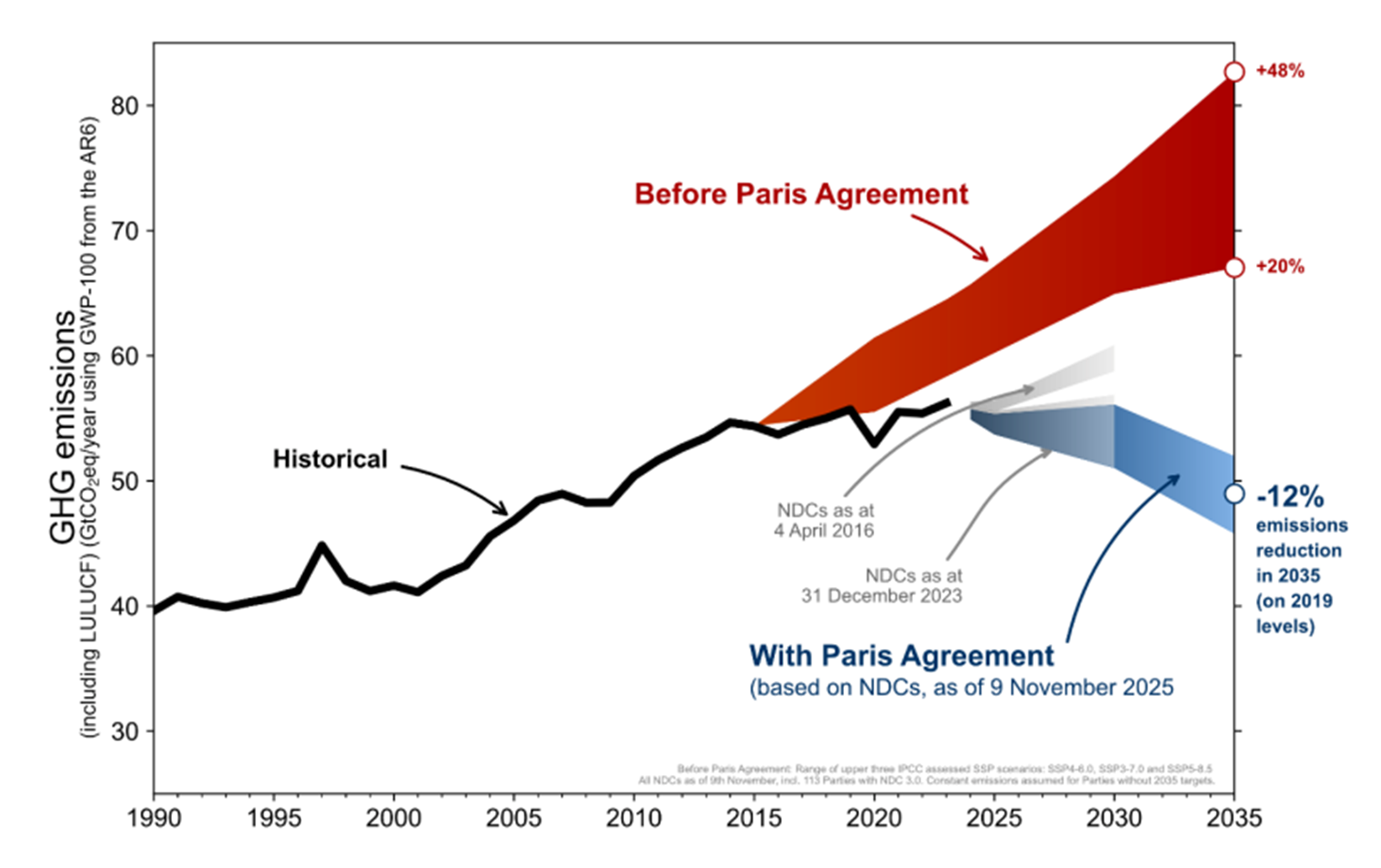
Source: UNFCCC secretariat (November 2025)
Even though it is recognised that the Paris Agreement is working, many Parties emphasised accelerating implementation, international cooperation and solidarity as a priority for COP30. This responds to the urgency flagged by the first Global Stocktake at COP28 (GST Decision) and the gaps identified by the UNFCCC secretariat in its NDC synthesis report. The GST Decision calls on Parties to “transition away from fossil fuels in energy systems in a just, orderly and equitable manner, accelerating action this decade to achieve net zero by 2050” and to “phase out inefficient fossil fuel subsidies that do not address energy poverty or just transitions, as soon as possible”. The most contentious mitigation issue at COP30 was the pace and pathway for transitioning away from fossil fuels. Although not on the formal agenda, it dominated the political narrative, media coverage and high-level discussions. President Lula opened COP30 by urging global “roadmaps” to end fossil fuel dependence and halt deforestation, and more than 80 countries – including Australia – rallied behind a fossil fuel phase-out roadmap. However, no explicit fossil fuel language made it into the final decisions. That absence – initially described by the EU and higher‑ambition Parties as unacceptable – reflects entrenched divisions, with the Arab Group and the Like‑Minded Developing Countries opposing any fossil fuel references.
These dynamics shaped the possible outcomes on mitigation at COP30. Consequently, the formal negotiations under the MWP proved challenging. At COP29, talks on the MWP stalled, with certain emerging economies resisting any language on phasing out fossil fuels. In Belém, these divisions persisted beneath the surface and contentious MWP issues were channelled into high-level negotiations in relation to the Mutirão Decision.
Even though there was no express commitment to transition away from fossil fuels, Parties agreed to develop and establish the Global Implementation Accelerator and the Belém Mission to 1.5°C (see above).
In parallel, in the Mutirão Decision, Parties formally acknowledged that the global transition towards low greenhouse gas emissions and climate-resilient development is irreversible and the trend of the future, an important framing signal for long‑term investment decisions.
Australia and 23 other countries joined the Belém Declaration on the Transition Away From Fossil Fuels, co-led by Colombia and the Netherlands. The Declaration states that limiting warming to 1.5°C requires ending new fossil fuel projects and calls on signatories to prepare detailed, time-bound roadmaps to transition away from fossil fuel dependence. It also welcomes the recent ICJ advisory opinion on states’ climate responsibilities. Australia’s decision to join this Declaration is geopolitically significant, signalling that a major fossil fuel exporter is planning for low carbon future.
The MWP decision was a modest reflection on the outcomes of a series of global dialogues carried out in 2025, focused on mitigation opportunities across the forestry and waste sectors. It also plans for the extension of the MWP beyond COP31 next year. We consider the outcomes in relation to forestry in detail below.
Agreeing a set of adaptation indicators to assess progress towards the GGA was a key priority for negotiators at COP30. However, the final package fell short of expectations for many parties and remains deliberately non-prescriptive.
At the core of the outcome is a new framework to assess collective progress towards the GGA using the Belém Adaptation Indicators. After protracted negotiations, Parties approved a list of 59 voluntary indicators covering key sectors and themes. These indicators cover water resources, food security, health, ecosystems, infrastructure resilience and livelihoods, as well as cross-cutting elements such as finance, technology support and capacity-building. The idea is to provide a menu of metrics (such as numbers of people protected from climate disasters, or percentage of resilient infrastructure) that countries can use to track and report adaptation advances.
Parties also established a two-year work programme to operationalise the indicators and committed to reviewing them after the 2029 Global Stocktake. This forward work recognises that the indicators will need refinement and alignment with finance and implementation pathways if they are to drive real-world outcomes. Several Latin American Parties raised objections during the closing plenary, signalling likely revisiting of the GGA elements in coming years.
Importantly, the indicators do not create new legal obligations and do not establish standardised methodologies. Parties are invited (but not required) to use them in national reporting, including BTRs. In practice, the world now has a starting template for measuring resilience, but ongoing work will be needed to refine these indicators and encourage their widespread adoption.
Beyond the indicators, COP30 concluded the Baku Adaptation Roadmap, establishing a work programme for 2026–2028 through to the next Global Stocktake. The roadmap is intended to elevate adaptive capacity by supporting the development and implementation of NAPs and sharing best practices.
In addition, as noted earlier, Parties committed to tripling adaptation finance (qualified as in alignment with the NCQG) in the Mutirão Decision.
Unlike COP29, which closed without agreement under the Just Transition Work Programme (JTWP), COP30 delivered a concrete outcome by agreeing to develop a new Just Transition Mechanism (JTM) under the JTWP.
The JTM is designed to strengthen international cooperation, technical assistance, capacity-building and knowledge sharing to ensure that the transition to low-carbon economies is fair and inclusive. Its adoption long sought by trade unions, civil society and many developing countries marks real progress after last year’s stalemate. While the design will be developed in future negotiations, the JTM could include guidelines for supporting affected workers and regions, and mechanisms to fund retraining, economic diversification and protection for vulnerable groups.
Trade policy and unilateral trade measures (such as the EU carbon border adjustment mechanism) remained a contentious issue under JTWP negotiations but were ultimately dealt with in the Mutirão Decision (see above).
Transparency is central to the Paris Agreement’s accountability system. At COP30, attention focused on the move to the Enhanced Transparency Framework (ETF), which requires all Parties to submit BTRs by the end of 2024. These reports include greenhouse gas inventories, progress on NDC implementation and information on support provided and needed. COP30 discussions acknowledged these first reports and the learning curve involved. The Parties emphasised enhancing the transparency framework, noting the need to improve data quality and consistency as the ETF fully kicks in. There were calls for capacity-building to help developing countries produce robust BTRs and for flexibility provisions (which allow some leniency for least developed countries) to be applied carefully without undermining overall transparency.
Parties agreed on common reporting tables and formats for certain aspects of BTRs, refining the modalities agreed in Katowice at COP24. They also encouraged all Parties that have not yet done so to submit their BTR by the 2026 deadline.
With no central enforcement mechanism, civil society and investors are likely to continue scrutinising countries’ reported data to gauge progress toward NDC targets and the overall effectiveness of the Paris Agreement.
Given that COP30 was hosted on the edge of the Amazon, it was no surprise there was a strong narrative push to link climate action with biodiversity conservation.
This was accentuated by the launch of the TFFF by the Presidency in the lead-up to COP30. The TFFF is a Brazil-led proposal that seeks to compensate countries for preserving tropical forests, with 20 per cent of funds reserved for Indigenous peoples. More than 70 developing countries with tropical forests will be eligible to receive funds, across the Atlantic Forest, the Amazon and the Congo and Mekong basins.
As a blended finance vehicle, the TFFF aims to raise US$25 billion of subordinated capital to help raise an additional US$100 billion in debt from the private sector. Norway is the largest contributor so far with US$3 billion committed over the next 10 years (subject to certain conditions), while Germany, Brazil and Indonesia have each committed US$1 billion.
In addition, Brazil’s President Lula called for a roadmap to reverse deforestation outside of the formal negotiations. While no formal decision to take this forward was made at COP30, the Presidency has committed to taking this issue finto 2026 alongside the COP31 Presidency.
The key developments in the climate and biodiversity nexus occurred outside of the formal negotiation process. While there are no operative provisions in the Mutirão Decision regarding biodiversity or nature, the preamble:
Emphasises the importance of conserving, protecting and restoring nature and ecosystems to achieve the Paris Agreement temperature goal, including enhanced efforts to halt and reverse deforestation and forest degradation by 2030 in line with Article 5, and to protect other terrestrial and marine ecosystems that act as greenhouse gas sinks, while ensuring strong social and environmental safeguards.
Underlines the urgent need to address the interconnected crises of climate change, biodiversity loss and land and ocean degradation in a coordinated way. It also highlights the importance of protecting, restoring and sustainably managing nature and terrestrial, marine and mountain ecosystems for effective, lasting climate action. This reflects language under the GST Decision, which underscored that terrestrial and marine ecosystems function as sinks and reservoirs of greenhouse gases and that conserving biodiversity is integral net zero pathways with social and environmental safeguards aligned to the Kunming–Montreal Global Biodiversity Framework.
Potential mitigation opportunities for the forestry sector were also noted in the MWP decision in the context of reflecting on the outcomes of a series of global dialogues carried out during the year. The MWP decision recognises the:
Critical role of forests, including boreal, temperate and tropical forests, as well as mangroves, as carbon stocks and sinks and in enhancing climate resilience, biodiversity, water and food security, livelihoods in the context of poverty eradication, and sustainable development, as well as food security.
Vital role of Indigenous Peoples and local communities and the need to support them in the sustainable management and use of forests, as well as the importance of recognizing their land rights and traditional knowledge, including as a part of long-term mitigation policies.
Potential for synergies among mitigation, adaptation, biodiversity conservation, combatting desertification and sustainable development.
Challenges of addressing deforestation drivers alongside sustainable development and food security needs, as well as increasing climate risks like wildfires and droughts, which underscore the need for sustainable, climate-adaptive forest management.
Importance of sustainable management of forests in the context of socioeconomic needs.
The Presidency had floated a proposal under an agenda item on ‘cooperation with other international organisations’ to create ongoing coordination among the Rio Conventions (climate, biodiversity, desertification). A draft text envisioned a process to develop recommendations for enhancing policy coherence between climate and nature agendas. However, this faced pushback from Parties vocally opposed to anything they perceived might merge or entangle the conventions.
After three years of negotiations and despite Australia’s best efforts, it has been confirmed that Türkiye will host COP31 in Antalya. The division of responsibilities pursuant to the agreement between Australia and Türkiye is set out below:
Türkiye | Australia | |
|
|
While the outcome differed from some expectations and is seen as disappointing by many, we remain positive, as the arrangement gives Australia a strong leadership platform and an opportunity to advance the Pacific’s regional interests globally. Separately, Ethiopia was confirmed as the COP32, chosen unopposed by the African Group. Ethiopia will host COP32 in its capital, Addis Ababa.
Key takeaways for the private sector and implications for global climate action
COP30 succeeded in sustaining broad support for multilateralism despite significant geopolitical challenges and delivered several important outcomes both within and outside the formal negotiations that will shape domestic policy and decision-making. It is important for the private sector to understand these outcomes and emerging areas of focus, as they will influence expectations of business and create opportunities to contribute to and benefit from, growing climate finance flows and policy settings in a decarbonising economy. COP30 did not resolve all disputes, leaving major questions on fossil fuels and transition pathways for COP31 and beyond. The global direction is toward a low-emissions economy, requiring a managed decline of coal, oil, gas and related sectors.
Australia’s signing of the Belém Declaration ahead of its role as COP31 “Presidency of Negotiations” signals that organisations in the fossil-fuel value chain must begin or accelerate orderly transition planning. This trend is already visible: during COP30, South Korea, one of Australia’s major coal customers, announced it will phase out coal-fired power by 2040. Such shifts among key trading partners will directly affect Australian exporters. The upcoming 2026 conference in Santa Marta, Colombia – one of the world’s major coal export hubs is also expected to accelerate global roadmaps for transitioning away from fossil fuels, with significant market implications. COP30 demonstrated that the investment signals for the transition to a low carbon economy remain strong and there will be opportunities to showcase Australian success stories under the finalised COP31 arrangements. We will pay close attention to how Australia approaches the transition away from fossil fuels and the work being done to reduce barriers and scale up public/private finance.
Other areas of importance for businesses include:
Implementation of NDCs: 122 Parties have now communicated revised NDCs. The private sector should look to NDCs as signals to obtain clarity about a national government’s approach to climate action and use them to engage with governments on implementing strategies and programmes to achieve NDC goals. Australia’s more ambitious 2035 NDC target will cascade into domestic law and regulation.
Climate investment opportunities: The scaling-up of climate finance will likely open new investment opportunities in renewable energy, clean technology and emissions-reduction projects in developing countries. Australian banks and investors can expect multilateral and bilateral climate initiatives (for example, green infrastructure funds and blended finance vehicles) seeking private co-investment. In particular, sectors like energy, agriculture and infrastructure may see climate related export finance conditioned on climate goals.
Climate-related trade measures: COP30 saw significant divergence on language around trade-related measures (such as CBAMs). We will see further work done on assessing and responding to the impacts of carbon border adjustments and other trade-related measures on economic and climate policies over the next few years. Future trade agreements may integrate climate finance contributions.
Our Climate Change and Sustainability Team monitors climate and energy policy developments worldwide and uses decades of experience to assist private sector clients with regulatory responses, governance frameworks, decarbonisation pathways, transition planning, and climate and environmental risk management. We also deliver bespoke workshops for directors and executives on climate regulation and its interaction with disclosure and financing obligations.