The State Development Bill 2025 (Bill) is proposed to modernise Western Australia’s (WA) approvals framework for strategically significant precincts and projects. It aims to cut red tape and fast-track investment by empowering the Premier of Western Australia (Premier), and a new statutory Coordinator General (CG), to coordinate across public authorities and expedite approvals processes.
Importantly, the Bill emphasises maintaining robust environmental and heritage safeguards, expressly protecting the independence of existing regulators.
This article explores the Bill’s key mechanisms, the policy settings it seeks to advance and how aspects of it compare to the longstanding Queensland (QLD) CG model as set out under the State Development and Public Works Organisation Act 1971 (Qld).
Key takeaways
The Bill provides the Minister for State Development (Minister) (currently also the Premier) with the ability to designate a project that is of strategic significance to the state, or an area of the state, as a priority project (Priority Project). To facilitate and coordinate these Priority Projects, the Minister (or the CG acting on delegation) is granted statutory powers to work with a wide range of regulators to ensure projects progress efficiently.
However, the Bill centralises significant discretion with the Minister and CG, the practical benefits of which will depend heavily on the government’s willingness to declare Priority Projects and to use the associated powers proactively. As such, proponents must be able to demonstrate why their projects should be entitled to the benefits of these powers and it is the government, through the Minister / Premier and the CG, that will hold the discretion to assess and determine this.
Large-scale, strategically significant projects in the critical minerals, renewable energy and defence sectors stand to benefit the most, particularly those which are state-led, reflecting the Government’s current policy focus. That said, the framework is broad enough to be applied more widely.
The joint decision notice and modification order powers have the greatest potential reach, but their use must be carefully managed to avoid judicial scrutiny.
In its current form, the time frame notice power risks being relegated to exhortatory guidance rather than creating strict obligations of a public authority, given the lack of statutory consequences for non-compliance.
The Minister may also, with the approval of the Premier, declare an area that is of strategic significance to the state as a State Development Area (SDA). In doing so, the Minister and the CG will maintain high-level oversight of the planning and development of the area.
Several powers under the Bill are excluded from applying to the Environmental Protection Authority (EPA). Proponents seeking to streamline environmental approvals may find the EPA’s October 2021 Interim Guidance a more effective pathway than the Bill.
Overall, the Bill is a net positive for WA’s energy transition and broader investment agenda. But for now, collaboration levers remain with government rather than industry. Proponents will only benefit where the Minister and CG choose to deploy their powers – unlike the QLD regime, where proponents can apply to the CG to have a project declared significant.
Proponents should monitor the Bill’s progress and are encouraged by the government to reach out to the CG’s office (officeofthecoordinatorgeneral@dpc.wa.gov.au) with questions, feedback, or requests for further information.
Object and scope: coordinating state-significant development
The Bill aims to coordinate, facilitate and promote development of strategic or economic significance to the state, while considering social and environmental factors.
State-significant development is broadly defined as “industrial development, development of infrastructure, or other development or activities, of strategic or economic significance to the State”.
Policy focus: energy transition, strategic industrial areas and defence precincts
Government commentary, particularly the Minister’s second reading speech, offers insight into likely key priorities for the reforms.
Firstly, the Premier has said that the new laws are designed for the opportunity of “getting out of coal fired generation faster than any other Australian state”. This refers to the planned closure by Synergy of the Collie and Muja coal fired power stations later this decade. It is reasonable to assume that, at a minimum, the government has in mind certain state-led renewable energy projects across the state and Western Power’s Clean Energy Link transmission infrastructure upgrades, which are widely viewed as critical to WA achieving ambitious energy transition and decarbonisation goals.
Secondly, the Premier emphasises the opportunity to support our major trading partners to decarbonise by producing critical minerals and clean downstream products like green iron. Central to this will be the:
activation of the Strategic Industrial Areas in Kwinana and in the Pilbara, and elsewhere, that are the subject of potential green iron or other mineral processing projects;
delivery of the new common user infrastructure, such as the priority corridors forming part of the Pilbara Energy Transmission Plan; and
network investments identified in the SWIS Demand Assessment first announced in 2023.
Finally, the government announcements also highlight the opportunity for WA to become the largest naval shipbuilding and maintenance hub in the southern hemisphere. This comes off the back of the Federal Government's $12 billion investment to create the Henderson Defence Precinct and a more recent announcement regarding WA establishing its first standalone defence agency - Defence West.
Further comparisons with historical State Agreements that underpinned many of the state’s most significant projects, together with the government’s position that other major private‑sector projects will remain within the lead‑agency process led by the Department of Energy and Economic Diversification, lend additional support to these conclusions. At least initially, the most strategically significant precincts and projects stand to benefit the most particularly those that are state‑led.
Coordinator General and Minister’s role
The Bill establishes an independent office of CG within the Department of Premier and Cabinet.
The CG’s functions include:
identifying major projects suitable to be designated as Priority Projects;
coordinating and facilitating those projects;
recommending the making of notices and orders;
overseeing development in SDAs (including in the provision of infrastructure and services in relation to the Priority Projects); and
monitoring the implementation of improvement schemes.
Whilst the functions of the CG are broad, the Minister retains ultimate decision-making power, including in declaring a Priority Project or SDA (with the approval of the Premier). The Minister can delegate many powers to the CG, but not the powers in relation to declarations of Priority Projects and SDAs. The Bill also allows the Minister to issue written directions to the CG, which must be tabled in Parliament.
By utilising their information gathering powers in the Bill, the CG (and by extension the Minister) will potentially have access to an unprecedented body of project related information. For example, the CG may require a public authority to provide information that is relevant to “state development matters” (including the performance of a function of the CG or the Minister under the Act). Albeit the value of this information will only be realised if the CG and Minister are adequately resourced to analyse, manage and apply it effectively.
Projects and precincts – what does the Bill apply to?
Under the Bill a designation of:
a Priority Project enlivens the statutory powers that can be exercised to ensure its timely and efficient delivery; and
an SDA will provide for the delivery of land, infrastructure and services, with the CG playing a central role in overseeing and coordinating development.
Priority Projects
A Priority Project is formally designated via a notice issued by the Minister, with the Premier’s approval, after consultation with the person or public authority proposed to be nominated as the proponent for the project.
Before declaring a Priority Project, the Minister must:
have regard to the object of the Bill; and
be satisfied that the project is of strategic or economic significance to the state or to an area of the state. This includes being satisfied because of any infrastructure, capital investment, employment opportunities, economic benefits or social benefits that the project may provide. This list of considerations is not intended to be exhaustive, but merely inclusive.
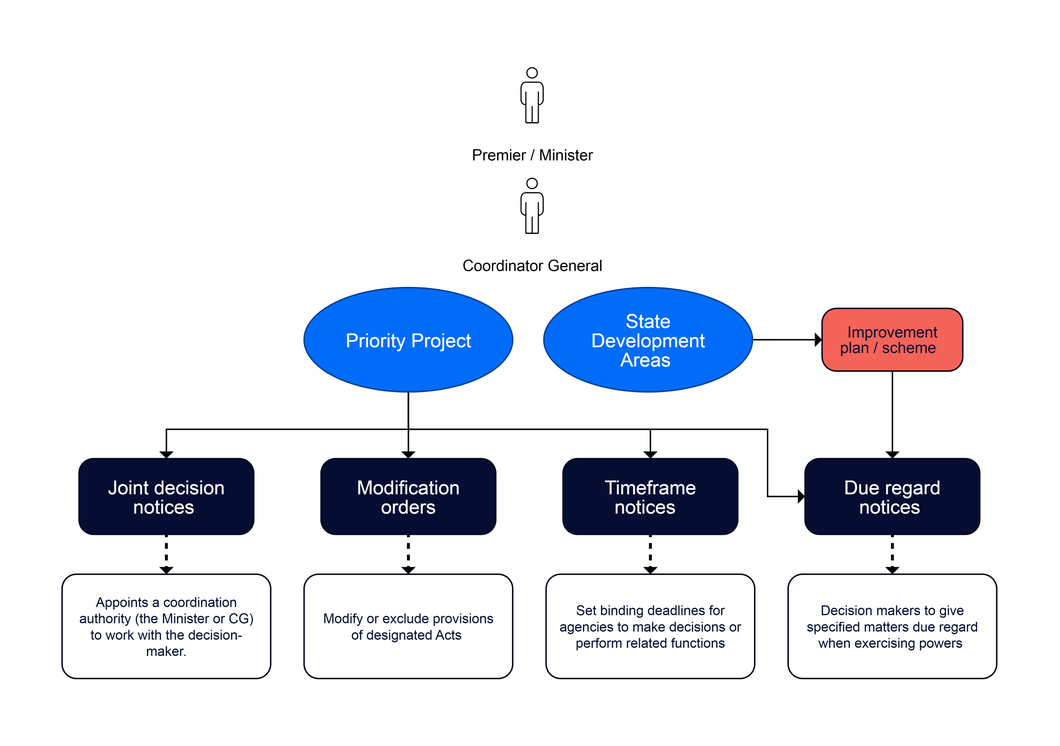
Once designated, the project becomes subject to the Bill’s special coordination framework and powers that can be taken advantage of to direct the exercise of decision-making and other functions under specified Acts, including:
timeframe notices;
due regard notices;
joint decision notices; and
modification orders.
The government has indicated that a project may be strategically significant if it delivers critical or common user infrastructure, or strong capital investment with economic or social benefit and job-creating opportunities.
State Development Areas
SDAs are geographic precincts declared by the Minister to support significant industrial or infrastructure development.
An SDA is declared by a written instrument, which will outline the strategic direction for the area, including economic, environmental and social considerations and is intended to guide decision-making by identifying future land uses, precinct objectives and infrastructure needs.
Additionally, an SDA can authorise the preparation of an “improvement scheme” and adoption of an “improvement plan” to embed the intent of the SDA in the planning framework and to provide further guidance on the use, zoning and reservation of land in the area.
All public authorities must give due regard to the applicable SDA plan when making decisions or exercising functions (including granting interests in land and making a decision under designated legislation that causes a development to be carried out). The CG has oversight of SDAs, and applications within them must be shared with that office as part of the broad information gathering functions of the CG.
Most of the Bill’s special notices and orders apply only to Priority Projects, not to projects solely by virtue of being within an SDA, with the exception of due regard notices.
Figure 1: State Development Bill in a snapshot
Timelines and touchstones: timeframe and due regard notices
Timeframe notice
Timeframe notices require public authorities to decide on Priority Project matters within a specified period. If the public authority considers it will not meet the timeframe, it can request the Minister to extend the timeframe. Timeframe notices may be given in respect of designated Acts under the Bill, as well as the Aboriginal Heritage Act 1972 (WA).
There are 40 designated Acts, including the EP Act, other environmental legislation, Planning and Development Act 2005 (WA), Land Administration Act 1997 (WA), Heritage Act 2018 (WA), Main Roads Act 1930 (WA), legislation relevant to mining and petroleum projects, utility services and public authorities, pipelines, ports and several other Acts.
Some guardrails apply to the provision of timeframe notices including that regulations can limit the functions a timeframe notice can be applied to, and before giving the notice, the Minister must consult with the relevant public authority, to consider the processes and requirements relevant to the function.
However, no consequences are specified under the Bill for an authority failing to meet the specified deadline which may diminish the practical force of the mechanism and risks relegating timeframe notices to exhortatory guidance rather than creating strict obligations.
In contrast, under the QLD regime, the CG may “step in” and assume the assessment and decision‑making function of a public authority if it fails to comply with a timeframe notice – an explicit consequence that may give that framework extra operational teeth.
Due regard notice
Due regard notices require public authorities to give specified matters due regard when making decisions on Priority Projects, though they are not directed to make a particular decision.
A due regard notice will enable the Minister (or the CG under delegation) to elevate the importance of certain matters to ensure that those matters are considered by the public authority in its decision-making process. Before giving a due regard notice, the Minister must consult the public authority to which it is proposed to be given.
A due regard notice cannot be given to the EPA, the Heritage Council of Western Australia or any other prescribed public authority, or in relation to any decisions prescribed in regulations. Restricting the ability of the Minister to give a due regard notice to these bodies acknowledges their independence and predominantly advisory function.
Further, a due regard notice cannot be given to another Minister regarding a decision they make personally unless the other Minister agrees to it.
In the SDA context, a due regard notice may be given in relation to a decision under a designated Act that could cause or allow development or an activity in an SDA to be carried out.
Fast decisions, custom conditions: joint decision and modification orders
Joint decision notices
Joint decision notices appoint a coordination authority (the Minister or CG) to work with the public authority that is responsible for making a decision under a designated Act that could cause or allow a Priority Project to be implemented.
A joint decision notice requires the coordination authority and the responsible public authority to consult and seek agreement on a designated decision; if unresolved, the matter escalates to responsible Ministers and then to the Premier for a final decision.
It also means the responsible authority may have regard to the objects of the Bill in making the designated decision.
A joint decision notice cannot be given to the EPA, the Heritage Council of Western Australia, or the WA Planning Commission. In contrast, under the QLD regime, the CG is empowered to coordinate environmental assessment and impose conditions following that assessment.
Modification orders
Modification orders allow the Minister (with the Premier’s approval after consultation with the proponent and affected agencies) to unilaterally amend or exclude certain provisions of a designated Act for a Priority Project.
The Minister may not make a modification order unless it is appropriate because, in their opinion:
making the order will prevent or reduce the duplication of administrative processes; or
having regard to the object of the Bill, as well as the purpose of the relevant Act being modified, making the order will not prevent the Priority Project from being effectively regulated under law.
A modification order is a significant power, and in the readings of the Bill, the Minister stated that power is designed to streamline regulatory processes in which provisions of legislation may unnecessarily delay or duplicate processes, without compromising essential safeguards. It was emphasised that the power is not about bypassing necessary regulation or the need to hold a key regulatory approval.
As such, key guardrails apply which are aimed at ensuring the appropriate use of this power. For example, a modification order:
must be presented to each house of Parliament and may be disallowed following a resolution from either house;
cannot remove requirements to obtain a “key regulatory authorisation” (namely, those that authorise the carrying out of development or an activity, or requirements to obtain an interest in land or a right to access or use land); and
cannot modify the Aboriginal heritage regime (amongst other legislation not listed as a designated Act).
However, it is permissible for a modification order to exclude or modify the grounds, purpose, process, requirements or criteria applicable to the grant of the authorisation.
The Minister can also impose project-specific conditions within a modification order. Recently, the QLD regime has attracted scrutiny in relation to the CG’s power to impose conditions which take precedence over and are inconsistent with conditions imposed by public authorities.
Opportunity and risks
Joint decision notices along with modification orders have the greatest potential reach out of the Bill’s powers and, for that reason, present both an opportunity and a risk.
Properly deployed, they create a single point of accountability capable of breaking inter‑agency deadlock and compressing decision pathways that often stall Priority Projects. But their potential breadth also carries material implications for institutional balance and may invite judicial scrutiny as they can essentially recalibrate the application of existing statutory tests or procedural steps in relation to a decision.
The more ad hoc and project specific the interventions are, the greater the risk that such intervention may be the subject of judicial review proceedings, ultimately protracting approval processes and defeating the object of the Bill.
How else can proponents streamline the approval process?
The Bill maintains the EPA’s independence and doesn’t override environmental assessment obligations.
Proponents seeking streamlined approvals should look to the EPA’s 2021 Interim Guidance. This guidance allows the EPA to rely on other statutory processes that address environmental impacts, narrowing its own scope and enabling more efficient assessments.
This is particularly pertinent where a proposal’s principal impacts will be regulated through separate approval pathways. For example, impacts to Aboriginal heritage that trigger a distinct consent process under heritage protection legislation. By enabling the EPA to rely on these parallel processes, the Interim Guidance can afford greater scope for the EPA to narrow the range of factors considered during environmental assessment, thereby facilitating a more proportionate and efficient assessment framework.
What should proponents do?
The Bill holds significant promise, but the benefits will flow only if government actively uses the powers it creates. Proponents should stay close to developments and be ready to respond. Specifically, proponents should:
monitor the Bill’s progress, which may pass by the end of 2025;
engage early with the CG’s office to understand opportunities;
seek to position their project to align with WA’s policy goals and be prepared to respond to any changes in the legislative or regulatory landscape as the Bill advances through Parliament; and
for environmental matters, explore using the EPA’s existing streamlined pathways.