Climate litigation is no longer an emerging risk, but rather a ‘permanent feature of the global governance landscape’. The Grantham Research Institute on Climate Change and the Environment and the Sabin Center for Climate Change Law published the eighth edition of their Global Trends in Climate Change Litigation series: the 2026 Snapshot (2026 Snapshot). The 2026 Snapshot’s central finding is that climate litigation has moved beyond novel strategic litigation to become a permanent feature of global climate governance and the risk landscape.
This article distils the key themes from the 2026 Snapshot and examines their implications for corporates, directors, financial institutions and government in Australia. It also sets out practical takeaways to help organisations respond to this evolving risk landscape.
Key insights:
- Climate litigation has become a mainstream legal and commercial risk: The 2026 Snapshot confirms that climate litigation is now an established feature of global climate governance, with cases continuing to expand in number, geography and sophistication, and overseas decisions increasingly influencing Australian courts.
- Corporate liability is moving beyond threshold disputes: Strategic claims against companies are increasingly surviving early procedural challenges, supported by developments in attribution science and theory, and arguments that seek to translate State climate obligations into corporate duties.
- Climate-washing remains the most active corporate risk area: Disclosure, net zero claims, transition plans, offsets, investor communications and greenhushing are all potential sources of claims, with activists and Australian regulators continuing to scrutinise the basis and substantiation of climate-related statements.
- Financial institutions face growing financed-emissions exposure: Banks, insurers, superannuation funds and asset managers should expect closer scrutiny of financed emissions, stewardship, target-setting and transition disclosures as emissions-accounting methodologies become more robust and litigation-ready. Professional services firms should also remain alert to growing attention on advised emissions, which are the indirect greenhouse gas (GHG) emissions associated with professional services provided to high-emitting clients. Reputational and greenwashing risks may emerge as emissions methodologies and sustainability reporting and assurance obligations continue to evolve.
- Australian organisations need board-level controls: Companies and government bodies should treat climate litigation as a multi-directional risk affecting strategy, disclosure, approvals, supply chains and governance, and ensure decisions related to climate commitments are coherent, evidenced and defensible.
Expanding climate cases and legal implications across borders
In the last 40 years, more than 3,600 climate cases have been filed globally, with 249 filed in 2025 alone. Over three-quarters of all cases have been filed since the adoption of the Paris Agreement in 2015. Some 215 cases against governments since 2015 have reached an apex court.
Cases have now been brought across 62 countries, up from just 17 a decade ago, with new filer countries in 2025 including Grenada, Guatemala, Kazakhstan, Malaysia, Singapore and Zambia.
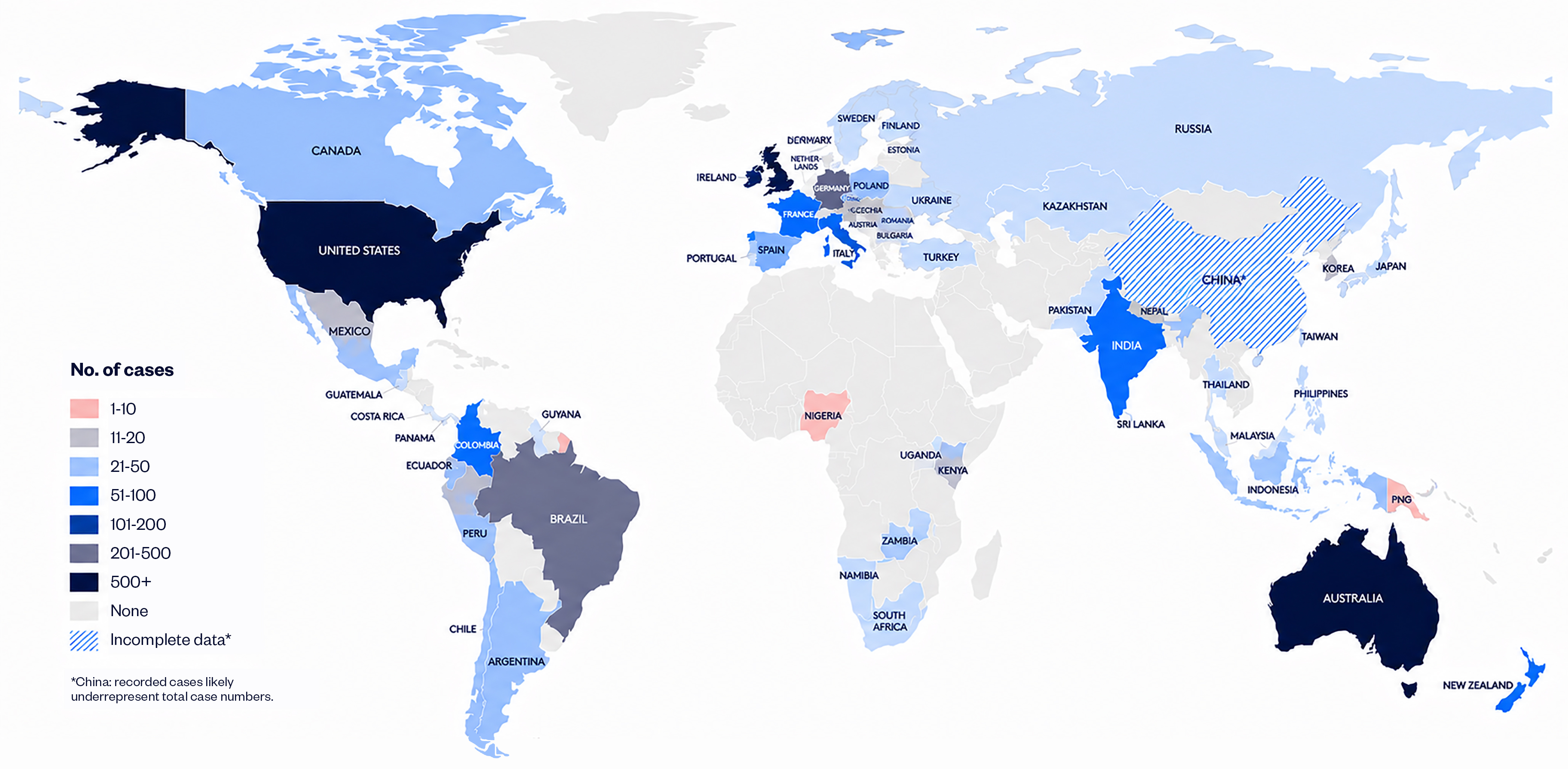
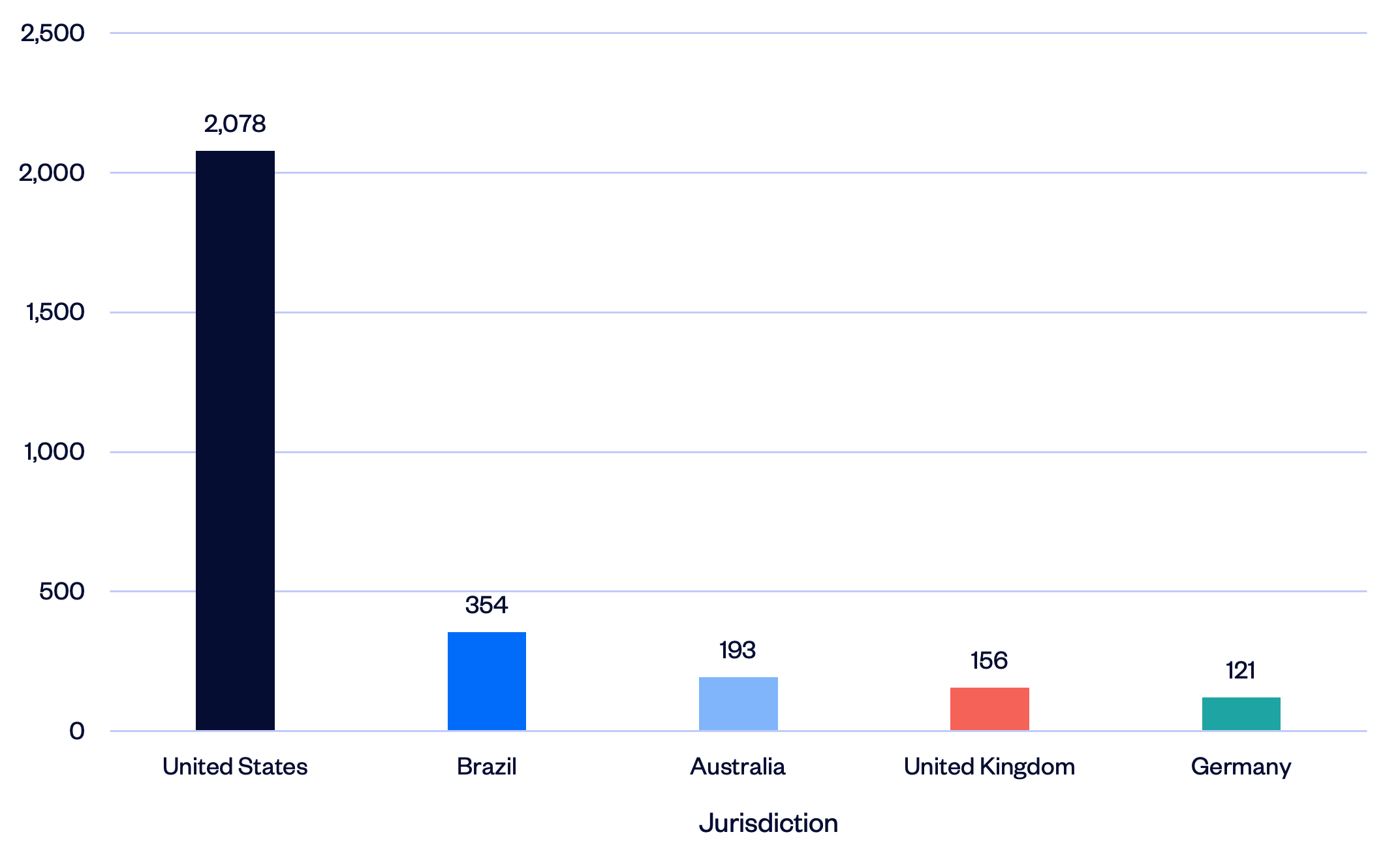
The United States remains the highest-volume jurisdiction (151 new cases in 2025; 2,078 in total). Outside the United States, the leading jurisdictions are Brazil, Australia, the United Kingdom and Germany.
But it is not just the number of cases increasing; the cases are also maturing rapidly. The suite of advisory opinions delivered between 2024 and 2025 by the International Tribunal for the Law of the Sea (ITLOS, 21 May 2024), the Inter-American Court of Human Rights (IACtHR, 10 July 2025) and the International Court of Justice (ICJ, 23 July 2025), are anchoring the consolidation of States’ climate obligations as legal duties, not merely political choices.
Courts in different countries increasingly rely on one another’s climate decisions. A ruling overseas may directly influence outcomes in Australia. The 2026 Snapshot highlights that new climate cases rarely emerge in isolation – they tend to replicate, adapt and build on existing climate decisions from other jurisdictions. Australia, the UK and New Zealand are among the jurisdictions whose courts most frequently cite foreign climate litigation decisions. The ICJ Advisory Opinion has already been relied on in numerous proceedings globally, including in the High Court of Australia.
Corporate liability: from threshold battles to merits-stage risk
Historically, most climate cases have been filed against governments. However, in recent years, more cases have been filed against private companies. In 2025, more than 50 strategic climate-aligned cases were filed against companies, bringing the total to around 434 since 2015, spanning energy, finance, transport, real estate and consumer goods. State-owned enterprises and financial institutions are defendants in at least 42 of those cases. While the legal framework concerning corporate climate obligations is at an earlier stage than the case law concerning States, there have been several recent significant developments.
Increase in aggregate emissions liability claims
The 2026 Snapshot identifies a material shift in corporate climate-related claims. Courts in several jurisdictions are increasingly willing to consider corporate claims on their merits, rather than dismissing them as part of threshold challenges. The three main types of corporate claims are:
- indirect emitter claims, which rely on conventional negligence for localised, provable damage
- aggregate emissions liability claims, which assert that a company bears responsibility for its share of global emissions
- corporate framework cases, which challenge a company’s overall climate strategy or transition plan.
While indirect emitter claims have seen the furthest progression to date, the 2026 Snapshot highlights that aggregate emissions liability claims are now also surviving early procedural challenges in a growing number of jurisdictions (outside of Australia). For example, in Asmania et al. v. Holcim, inhabitants of the Indonesian island Pari brought proceedings in July 2022 against Swiss cement manufacturer Holcim seeking proportional compensation for climate-related damages on Pari, financial contribution to adaptation measures on Pari, and an emissions reduction order requiring Holcim to reduce its CO2 emissions by 43% by 2030 and 69% by 2040, relative to a 2019 baseline. On 17 December 2025, the Cantonal Court of Zug held that both the damages and the forward-looking emissions reduction remedy are admissible.
No aggregate emissions liability or corporate framework case has yet resulted in a final order requiring behavioural change or the payment of damages. However, the shift from threshold dismissal to substantive engagement represents a material shift in the risk landscape.
Evolving evidence base: increasing climate attribution science
Earlier editions of the Grantham Institute’s reports noted that many claims had difficulty establishing attribution. More recent claimant strategies are increasingly relying on attribution studies which seek to connect particular climate impacts with emissions associated with individual companies, sectors or projects. The extent to which those studies will be accepted by courts, and the legal consequences that may follow, remains highly fact- and jurisdiction-specific.
Since 2020, there have been significant admissibility decisions in about 30 aggregate emissions liability and corporate framework cases, with roughly half allowed to proceed. This may indicate that claimants are increasingly presenting more developed causal arguments and making more targeted use of attribution evidence. However, admissibility outcomes themselves are not indicative of courts’ acceptance of the underlying science or the substantive claims put before the court.
Litigation raising the costs of new fossil fuel production
The 2026 Snapshot highlights new legal norms on State obligations in cases concerning fossil fuel exploration and production. Both the UK Supreme Court in R (Finch on behalf of the Weald Action Group & Others) v. Surrey County Council (& Others)and the European Court of Human Rights in Greenpeace Nordic v. Norway have indicated that, under the law of the European Union, scope 3 GHG emissions from high-emitting projects must be quantified and assessed before such projects can proceed. For energy companies, scope 3 emissions typically represent 70% to 90% of life cycle emissions.
In Australia, the High Court (Australia’s apex court) is currently considering the causal connection between a large mine’s contribution to global emissions (including scope 3 emissions from burning coal) and specific climate impacts on the local community in DAMSHEG v MACH Energy (discussed further below).
The ICJ Advisory Opinion: from recognition to remedy
On 23 July 2025, the ICJ unanimously delivered its Advisory Opinion on the Obligations of States in respect of Climate Change (ICJ Advisory Opinion), which was adopted by the United Nations General Assembly in May 2026. The landmark opinion, which clarified States’ climate change obligations, is a significant development underpinning the 2026 Snapshot’s shift from recognition of obligations to remedy for breaches of those obligations.
For companies, the ICJ Advisory Opinion’s significance lies in its potential to reshape how domestic courts assess statutory obligations in the context of climate change. Although the opinion does not bind Australian courts, as international law must first be adopted into Australia’s domestic law before it becomes binding, it is already being cited in private litigation. This includes in the recent Full Federal Court appeal in Pabai Pabai v Commonwealth (discussed further below) and in the second Milieudefensie v Shell case (‘no new oil and gas fields case’). In the second Milieudefensie case, the Dutch environmental organisation relied on the ICJ Advisory Opinion to argue that obligations owed by States translate, at least in part, into obligations owed by companies that are said to be major emitters. While that argument may ultimately be unsuccessful, we can expect that similar arguments may be made by claimants in Australian domestic proceedings in due course.
In this regard, in March 2026, Ruth Higgins SC, Zoe Bush and Jennifer Robinson published a joint legal opinion, concluding that the ICJ Advisory Opinion, though non-binding, may over time raise the standard of care expected of company directors under section 180(1) of the Corporations Act 2001 (Cth). The standard under section 180(1) is objective and fact-intensive: a director must exercise the care and diligence that a reasonable person would in their position. As climate-related legal and scientific developments accumulate, the body of information a reasonable director is expected to consider, and act on, necessarily grows. The opinion concludes that “the days of the sleeping, or passive, director are well and truly over”.
Given its recency, the opinion has not yet been directly cited in legal proceedings or court judgments. However, it follows a suite of legal opinions on directors’ duties in the context of climate change from Noel Hutley SC, Sebastian Hartford-Davis SC and Zoe Bush, which have gained prominence as an authoritative analysis of directors’ climate-related exposure.
Key remedy-phase cases
Several cases now before the courts illustrate the pivot from recognition to remedy:
- Milieudefensie v Shell (first case): In November 2024, the Hague Court of Appeal quashed the earlier 45%-by-2030 reduction order but affirmed Shell’s responsibility to reduce emissions consistent with the Paris Agreement’s temperature goals. The Dutch Supreme Court heard the appeal on 22 May 2026, with judgment pending. The Dutch approach illustrates an alternative doctrinal pathway that claimants may seek to import: framing a company’s emissions trajectory as a question of reasonable care rather than statutory compliance. The Dutch Supreme Court’s pending judgment will be a significant benchmark for whether that duty survives appellate scrutiny.
- Lliuya v RWE: A German court accepted, in principle, that a company could be liable for a share of climate damage proportional to its share of global emissions, even where the harm in question (in this case, glacial flood risk in Peru) occurred far from the company’s operations and decades after the relevant emissions. Although the specific claim was dismissed on the facts, the proportionate liability principle is now being tested in follow-on cases.
- Pakistan Climate Cost Case (filed 22 December 2025): 39 Sindh farmers are seeking compensation from RWE and Heidelberg Materials for 2022 flood losses. This is one of the first attempts to convert the proportionate liability principle in Lliuya v RWE into an active compensation claim and its progress will indicate whether German courts are prepared to quantify (not just recognise) corporate liability for historical emissions.
- Milieudefensie v Shell (second case, filed April 2026): In this case, the Dutch environmental organisation seeks to stop production from new oil and gas fields and set reduction targets to 2050, expressly invoking the ICJ Advisory Opinion. The summons – which demands Shell “cease, continue to cease and not restart the production from new oil and gas fields”, with no offsetting by carbon credits – reflects claimant strategy moving from broad declaratory relief towards more targeted, enforceable remedies. Shell is defending the claim and maintains that the cease-production demand ignores “the role that oil and gas will continue to play in the coming decades”.
Climate-washing and disclosure risk
Climate-washing remains the most common type of case involving companies. The 2026 Snapshot records at least 226 climate-washing cases globally, with 31 new cases filed in 2025. More than 65% of climate-washing cases with recorded outcomes have been decided in the claimant’s favour (2026 Snapshot). Climate-washing claims, unlike aggregate emissions liability claims, do not require a claimant to prove a novel duty of care. Instead, they apply well-established consumer protection, corporations and securities laws to a new factual context.
Climate-washing litigation has grown steadily since the late 2010s, accelerating sharply after 2020. While the Grantham Institute’s 2022 Snapshot report identified climate-washing litigation as “gaining pace”, the 2023 and 2024 reports documented rapid growth in claims challenging net zero commitments, product claims and climate-related financial disclosures. The risk landscape now encompasses transition plans, net zero commitments, ‘clean’ or ‘climate-neutral’ product claims, carbon-offset claims, investor communications, consumer claims and broader corporate narratives. For companies operating across multiple jurisdictions, the risk is compounded by inconsistent or unclear regulatory expectations: a claim that is defensible in one market may not withstand scrutiny in another.
Withdrawing climate commitments in response to political pressure – coined ‘greenhushing’ – may not necessarily eliminate legal risk; it may shift it. The recent proceedings in Instituto Brasileiro de Defesa do Consumidor (IDEC) vs. Gol Linhas Aéreas S/A (Greenwashing in aviation), Brazil’s first judicial climate-washing case, illustrate that pre-emptive retreat may not extinguish legal exposure but rather, may itself evidence awareness of wrongdoing in subsequent proceedings. In 2025, the Brazilian Institute for Consumer Protection (IDEC) filed civil proceedings against Gol Linhas Aereas (GOL) in the São Paulo state court seeking declarations of greenwashing, counter-advertising and collective moral damages regarding GOL’s passenger offset programme. These proceedings followed IDEC’s investigation into concerns regarding GOL’s offset programme and notwithstanding that GOL had discontinued the programme and removed related publicity. IDEC relied on the ICJ and IACHR Advisory Opinions recognising the climate emergency as a human rights issue and the duty of States (and economic agents) to ensure access to clear, science-based environmental information. Although GOL contested the allegations, defending its sustainability efforts and partnerships, in June 2026, the court upheld the claim and ordered GOL to cease environmental communications without auditable technical proof, conduct counter-advertising, to remove its ‘GOL Green Plane’ branding and pay collective moral damages.
On 17 February 2026, the Federal Court of Australia (Markovic J) dismissed claims in Australasian Centre for Corporate Responsibility v Santos Limited [2026] FCA 96 that Santos’ ‘clean energy’ language and 2040 net zero target were misleading. The Court found that Santos’ use of ‘clean energy’ and ‘clean fuel’ had no fixed meaning and that Santos had done extensive internal work to support its target. The decision is on appeal. The ACCR states that “the judgment sets the bar for corporate communication about climate commitments well below market and investor expectations”. However, Santos maintains that the initial landmark judgment was correct and that its climate targets and terminology were backed by reasonable grounds. See our insight on the first instance judgment for further details.
Other recent Australian developments include EnergyAustralia’s ‘Go Neutral’ apology and settlement, and ASIC’s continued enforcement against greenwashing (including proceedings against Australian Gas Networks and Fiducian Investment Management Services (FIMS)).
In Parents for Climate v EnergyAustralia, Parents for Climate launched proceedings in July 2023 in the Federal Court alleging that EnergyAustralia’s marketing of its ‘Go Neutral’ carbon offset product amounted to misleading or deceptive conduct under the Australian Consumer Law. In May 2025, the parties entered into a settlement, with EnergyAustralia publishing an agreed apology statement, acknowledging the limitations of carbon offsetting, the shortcomings of its product messaging and confirming the withdrawal of EnergyAustralia’s Go Neutral product.
In the FIMS case, ASIC sought declarations that FIMS contravened s 12DF of the Australian Securities and Investments Commission Act (ASIC Act) and s 601FC(1)(b) of the Corporations Act 2001 (Cth), by making false or misleading statements in relation to the Diversified Social Aspirations Fund (DSA Fund) and by failing to discharge its duty to act with care and diligence in relation to the DSA Fund. FIMS admitted to the alleged contraventions. On 11 August 2026, the Supreme Court of New South Wales ordered, by consent, FIMS to pay a $7.3 million penalty for breaching its duty to act with care and diligence as a responsible entity and engaging in conduct likely to mislead the public about its ‘ethical’ and ‘socially responsible’ investment objectives (In the matter of Fiducian Investment Management Services Pty Ltd [2026] NSWSC 959).
We expect greenwashing to remain an enduring enforcement priority for ASIC, the ACCC and activists.
For all reporting entities under Chapter 2M of the Corporations Act, now captured by Australia’s mandatory sustainability reporting regime, the new framework will sharpen the intersection between disclosure, governance and litigation risk. The mandatory reporting will create a more structured, comparable and transparent evidentiary record of climate governance, strategy, risk management, metrics and targets, which may be relied on by regulators, shareholders, counterparties and claimants in future climate-washing, continuous disclosure or directors’ duties claims. There is an initial transitional period during the phasing in of the obligations, in which certain modified liability settings limit who may bring proceedings in relation to certain protected sustainability-report statements, but those settings do not prevent criminal action or ASIC action. See our insight on the climate-related financial disclosures for more information.
Financial institution exposure: from disclosure to financed emissions
Financial institution exposure is moving from climate-risk disclosure toward financed-emissions accountability as attribution methodologies mature. While the Grantham Institute’s 2022 report identified a shift from disclosure toward prudent financial management and portfolio emissions, the 2026 Snapshot records at least 49 such cases, including five filed in 2025.
New accounting methods now allow regulators and claimants to measure how much of a borrower’s emissions can be attributed to the bank or fund that financed them. These methods, including the Partnership for Carbon Accounting Financials (PCAF) methodology, are becoming sufficiently robust and standardised to support legal claims.
European and North American regulators and courts are now actively testing financial institutions’ liability for their financed emissions, including in the Netherlands (Milieudefensie v ING Bank NV), Canada (Hirji v Canada Pension Plan Investment Board), and the United States (Bank Climate Advocates v US Treasury). In Australia, the Australian Prudential Regulation Authority (APRA) has not yet taken equivalent formal enforcement action against an Australian institution, but its existing prudential guidance on climate risk already sets supervisory expectations for governance, risk management and disclosure that closely track the issues underlying these overseas actions. This means that the regulatory framework for an analogous Australian enforcement action already exists, although has not yet been tested.
Financial institutions should continue to treat climate litigation and financed-emissions risk as board and risk committee matters. For Australian banks, insurers, superannuation funds and asset managers, as noted above, greenwashing remains an ASIC enforcement priority, with expectations of closer scrutiny of lending practices, target-setting and transition disclosure. Australia’s compulsory superannuation system creates a distinctive claimant profile: fund members, for example, have brought claims against trustees for alleged breaches of duty in relation to climate risk management. This was illustrated by McVeigh v Retail Employees Superannuation Trust (REST), filed in the Federal Court of Australia in July 2018, in which a REST member alleged failures to disclose and manage climate-related financial risks. The matter settled on 2 November 2020, with REST agreeing to incorporate climate change financial risks into its investment approach and implement a net-zero-by-2050 carbon footprint goal.
Beyond the risks posed to financial institutions by financed emissions, we are also seeing increasing attention on ‘advised emissions’, meaning the indirect GHG emissions associated with professional services and strategic work provided to high-emitting clients. Advised emissionsmay present an emerging category of risk for professional services firms because they extend emissions inventories beyond a firm's own operations or investments to the advisory, assurance and structuring work that enables or supports high-emitting activity. Although advised emissions are not yet a settled basis for direct emissions liability, firms that provide professional services to emissions-intensive clients may face reputational harm where a firm's public sustainability commitments are inconsistent with its client portfolio, professional negligence claims where advice or assurance is alleged to have been deficient, and regulatory scrutiny as mandatory sustainability reporting and assurance obligations mature.
The two-directional risk environment: backlash and protective litigation
Earlier editions of the Grantham Institute’s reports framed litigation as a ‘double-edged sword’, capable of strengthening or weakening climate regulation. The 2026 Snapshot formalises this more sharply, distinguishing what it terms ‘anti-climate litigation’, non-climate-aligned litigation and protective climate litigation. According to the 2026 report, around 12% of 2025 filings can be termed ‘anti-climate litigation’, which it describes as litigation for the purpose of countering climate action, such as SLAPPs (‘strategic lawsuits against public participation’).
The US government’s response combines executive action and deregulation with private anti-ESG claims. Two examples illustrate these pressures:
- The February 2026 Vanguard settlement (USD29.5 million with 13 Republican state Attorneys-General, no admission of liability), exemplifies anti-ESG commercial pressures. The underlying theory is that incorporating climate or other ESG factors into investment decision-making may itself breach fiduciary duties. This inverts the theory underlying Australian greenwashing enforcement, where the risk lies in overstating ESG credentials. Australian trustees should understand that the same investment decision can generate liability risk in opposite directions in different regulatory environments.
- In Energy Transfer LP v Greenpeace International, termed a SLAPP lawsuit, a North Dakota jury determined that three Greenpeace entities were liable for more than USD667 million in damages. Almost a year later, in February 2026, the trial judge awarded USD345 million to Energy Transfer, an American energy company. While SLAPP suits are a growing concern globally, Australia currently lacks comprehensive anti-SLAPP protections. Entities considering potential similar claims will need to weigh associated reputational risks, including where it appears such litigation is being used for the purpose of suppressing public interest advocacy.
About 20% of US climate cases filed in 2025 can be classed as protective litigation. The trend is also visible in Canada, Europe and Brazil.
In July 2026, major oil and gas producers submitted a notice of dispute against the European Union, alleging breaches of the Energy Charter Treaty. The claim, brought by a group of companies active in the energy and petrochemical sectors, relates to the European Union’s 2024 Net-Zero Industry Act, which requires certain oil and gas producers to contribute to achieving 50 million tonnes of annual CO₂ storage capacity by 2030. This claim, which is brought under an investor-State dispute settlement (ISDS) mechanism, challenges the feasibility of the statutory requirements and calls for changes to the policy framework instead of fixed regulatory obligations. The case reflects the broad range of climate-related claims, including disputes involving pipeline cancellations, windfall taxes, gas-field closures and energy transition policies.
Emerging frontiers
The 2026 Snapshot identifies several emerging frontiers that extend climate litigation into new sectors and claim types, many of which are directly relevant to Australia’s economic and regulatory landscape.
Infrastructure and technology
Carbon capture and storage and carbon dioxide removal infrastructure (CCS/CDR) is an emerging litigation frontier. Disputes cover property rights, storage capacity, liability allocation and who should bear the costs of long-term storage. In Australia, where CCS features prominently in the national emissions reduction strategy and in the transition plans of major emitters, these disputes are likely to become more common as project development accelerates. Flashpoints are likely to include the long-term post-closure liability, access to storage capacity, and challenges to the adequacy of monitoring regimes underpinning CCS-based emissions reduction claims.
The rapid expansion of data centres and AI infrastructure also presents a new frontier, driven by their substantial energy consumption, water use and associated environmental impacts. As Australia’s digital infrastructure pipeline grows, these concerns may generate planning, environmental and climate-washing litigation.
State-linked actors
The 2026 Snapshot identifies State-owned or controlled enterprises (SOEs), including financial institutions, as shifting from peripheral to central defendants in climate litigation. Claims against SOEs now target energy and infrastructure projects, credit agencies, emissions reduction initiatives, and climate risk reporting. Several categories of claims are unique to government and SOE defendants:
- judicial review of government decisions: Friends of the Earth v UK Export Finance [2023] EWCA Civ 14 (government financing decision), and DAMSHEG v MACH Energy (project approval, discussed further below);
- common law negligence against government climate policy: Pabai Pabai (discussed furtherbelow), and Sharma; and
- freedom of information claims: Bank Climate Advocates v US Treasury.
Some claims also target both SOEs and private entities, but through different framing. For example, in aggregate emissions liability cases, claims against an SOE or its government shareholders focus on shareholder liability for failing to use a controlling position to steer the company’s emissions strategy. Against private companies, claims are framed as direct tortious liability for the company’s own emissions.
The Italian Supreme Court decision in Greenpeace Italy et al v ENI S.p.A et al (decision in Italian)illustrates this distinction. There, the claimants argued that ENI (partially State-owned) owed a duty under Italian tort law, the Paris Agreement, the Italian Constitution and the European Convention on Human Rights to adopt a decarbonisation strategy consistent with 1.5°C. The government shareholders – the Ministry of Economy and Finance, and Cassa Depositi e Prestiti S.p.A (CDP), a joint-stock company under public control, acting as a public development bank – were sued as co-defendants on the basis they held sufficient shares (about 33%) to exercise a dominant influence over ENI, but failed to use that position to direct ENI’s climate strategy.
The Court drew a clear distinction between the two types of defendant. While it treated ENI as a private company, the Ministry and CDP were treated as controlling shareholders, rather than as public authorities. The Court contrasted this case with a separate proceeding in which claimants had sought to compel the Italian government, in its capacity as a regulator and legislator, to adopt emissions reduction measures. In that case, the Court found no jurisdiction because the claim targeted the State’s political and legislative functions. Here, the Ministry and CDP were accountable as shareholders exercising private-law powers.
For Australian companies that transact with or are funded by State-linked entities, this trend signals an expanding scope of litigation risk across supply chains and investment relationships. Australian State-owned companies operating across the energy, transmission or export credit sectors occupy a comparable position to their international counterparts and should expect growing scrutiny of their emissions pathways and public climate statements.
Converging environmental claims
Climate litigation is converging with broader environmental claims, including those concerning plastics, biodiversity, and ‘green-versus-green’ disputes (where one environmental objective conflicts with another, for example, renewables projects challenged on biodiversity grounds).
The 2026 Snapshot records ‘green-versus-green’ litigation in Australia, India and Romania, including claims in new sectors such as critical minerals and carbon markets. Adaptation litigation is another growing category, including insurer subrogation claims and coastal-adaptation disputes.
The broader trend to watch is the growing overlap between climate and nature-related risk. As nature-related reporting frameworks develop alongside climate disclosure regimes, the same ‘say-do gap’ that drives climate-washing litigation is likely to extend to claims about biodiversity, land-use and nature-positive commitments. Australian companies in the critical minerals, agriculture and infrastructure sectors should monitor this space closely.
Australian focus
Two developments warrant particular attention:
DAMSHEG v MACH Energy
- In September 2022, the Independent Planning Commission of NSW (IPC) granted development consent for the Mount Pleasant Optimisation Project, a proposal by MACH Energy Australia Pty Ltd (MACHEnergy) to extend the life of the Mount Pleasant Coal Mine in the Upper Hunter Valley by 22 years to December 2048. Denman Aberdeen Muswellbrook Scone Healthy Environment Group Inc (DAMSHEG), a community environmental organisation, appealed the IPC’s decision to the NSW Land and Environment Court, which was dismissed by Robson J in August 2024. DAMSHEG appealed to the NSW Court of Appeal.
- In July 2025, the NSW Court of Appeal overturned the primary judge’s decision ([2025] NSWCA 163), finding that the IPC had failed to consider a mandatory statutory consideration, with the effect that the development consent was invalid. The Court held that approval authorities must consider both a project’s impact on climate change and the impact of climate change on the surrounding built and natural environment.
- The matter is now before the High Court, Australia’s apex court, with judgment pending. The appeal, which was heard by the Court on 13 May 2026, turns on whether the IPC’s acknowledgement of global climate change, combined with the conditions addressing local bushfire and water risks, sufficiently demonstrates consideration of downstream climate impacts. If upheld by the High Court, project proponents may need to consider preparing more comprehensive climate impact assessments. This may also raise the evidentiary bar for approvals across Australia’s transition build-out, including across renewables, transmission, critical minerals, hydrogen, and CCS projects.
Pabai Pabai v Commonwealth of Australia
- Following the 2021-22 Sharma litigation, the Pabai Pabai proceedings have illustrated the difficulty of bringing common law negligence claims against the Australian government over climate policy.
- At first instance, the Federal Court of Australia dismissed a negligence claim brought by two Torres Strait Islanders. The Court accepted that climate change has had, and continues to have, ‘significant and deleterious impacts’ on the Torres Strait Islands, which have become more severe and frequent over time. However, it held that emissions target-setting is ‘high or core government policy’, which is not amenable to a common law duty of care. The Court also found that the claimants had not established the necessary causal link between the government’s conduct and the harm suffered. It separately held that the claimants’ cultural loss (Ailan Kastom) is not currently compensable in negligence under Australian law.
- In November 2025, the applicants appealed to the Full Court of the Federal Court. Hearings took place from 28 to 31 July 2026 and the judgment is now reserved. The ICJ Advisory Opinion, which post-dates the first instance decision, featured prominently in the arguments on appeal. However, while the ICJ Advisory Opinion recognises cultural harm as compensable under international law, no Australian court decision has yet recognised an equivalent path.
- Irrespective of the appeal outcome, government exposure to climate-related litigation is unlikely to diminish. Judicial review challenges by NGOs to specific project approvals granted by government remain live, including Australian Conservation Foundation Inc; Friends of Australian Rock Art Inc v Minister for the Environment and Water, challenging the North West Shelf extension in the Federal Court of Australia, and Whitehaven Coal Pty Ltd v Australian Conservation Foundation, seeking the refusal of approvals for Winchester South Coal Mine proposed for the Bowen Basin. At the international level, Australia’s acceptance of the ICJ’s compulsory jurisdiction, together with its anticipated ratification of the BBNJ Treaty (partly facilitated by the High Seas Biodiversity Act 2026 (Cth)), leaves open the prospect of inter-State claims, though none have yet materialised.
Key takeaways and recommended steps
Climate litigation is becoming a feedback mechanism for the energy transition. It is providing a vehicle to test whether corporate and government commitments can be substantiated, whether and how decisions account for climate risk, and whether and how costs associated with the energy transition ought to be allocated among corporate and government market participants. For Australian companies, continued attention to ensuring that climate strategy, disclosure and implementation are coherent, evidenced and defensible remains advisable.
The 2026 Snapshot reinforces several practical conclusions for Australian organisations navigating the climate litigation landscape:
- Corporate liability is moving toward merits-stage risk: Aggregate emissions liability and corporate framework cases have not yet produced a final upheld damages or emissions-reduction order, but threshold risk is materially increasing. A plausible litigation pathway is emerging through the Lliuya v RWE causation principle, increasing reliance on attribution studies, and the ICJ Advisory Opinion’s indivisibility reasoning. Emissions-intensive companies should monitor the Dutch Supreme Court’s pending Milieudefensie v Shell judgment and the progress of the Pakistan Climate Cost Case as leading indicators, and should stress-test their transition plans, historical emissions narratives and scope 3 disclosures against the kind of scrutiny those cases illustrate.
- Disclosure and climate-washing risk remain active: Transition plans, net zero claims, carbon offsets, investor communications and greenhushing are all potential points of exposure. Companies should continue to treat climate reporting as a board-level financial reporting exercise supported by appropriate evidence, internal controls and cross-market consistency. This should include assessing whether the business retains contemporaneous, documented evidence for material climate statements or targets.
- Climate litigation risk is multi-directional: Organisations may face claims or complaints for inadequate action, misleading action, excessive action or a failure to implement commitments. Boards should ensure this risk is managed proactively, including by auditing existing climate disclosures, ensuring representations are properly contextualised and qualified, documenting supporting assumptions and methodologies, and obtaining legal advice to manage regulatory and litigation risk. These steps should be revisited whenever the company makes, revises or withdraws a public climate commitment.
- Financial institution exposure: Financed emissions and prudential supervision are becoming central to climate litigation risk. Boards and trustees should ensure emissions accounting methodologies are embedded in portfolio monitoring and reporting, that stewardship and voting records are consistent with disclosed transition positions, and that superannuation trustees are prepared for member-driven claims.
- Government: Domestic duty-of-care claims may remain difficult after Pabai and Sharma, but the ICJ Advisory Opinion may provide a further basis for challenges to the country’s emissions reduction ambition and approvals for non-renewable energy projects. The Pabai appeal, the North West Shelf challenge, the Winchester South proceedings, and the DAMSHEG appeal remain live and may shift the climate accountability landscape.