This year’s UN Climate Change Conference, the 31st Conference of the Parties (COP31) will be held from 9–20 November 2026 in Antalya, Türkiye. For the first time in the COP's 31-year history, hosting (presidency) rights have been split between two countries. Türkiye is host and overall COP President and leads the Action Agenda, while Australia, through Minister for Climate Change and Energy the Hon Chris Bowen MP, leads the formal negotiations as President of Negotiations. Under the same arrangement, Pre-COP was held in the Pacific from 5 to 8 October 2026.
A decade into the Paris Agreement, the architecture of the global climate regime is largely built. The New Collective Quantified Goal on Climate Finance (NCQG) has been set, the Article 6 carbon markets are becoming operational and the first Global Stocktake (GST) has been completed. The central issues are now delivery and review.
This focus on delivery is reflected in statements made by the Presidency teams. The Australian Government has focused on turning Paris Agreement commitments into practical outcomes, while COP31 President-Designate Murat Kurum has highlighted the need for practical action as the Paris Agreement enters its second decade. In their joint letter to Parties of 5 October 2026, Mr Kurum and Mr Bowen pledged to turn ambition into real-world action with tangible outcomes for communities. The COP31 High-Level Climate Champion has described COP31 as a ‘people-centred, implementation-focused COP’, designed to convert the commitments made at recent COPs into measurable action.
COP31 takes place against an increasingly complex geopolitical backdrop. The United States’ withdrawal from the Paris Agreement took effect on 27 January 2026 and the US has since moved to leave the United Nations Framework Convention on Climate Change (UNFCCC). Ongoing regional conflict is straining cooperation, governments are reframing the energy transition and climate change as a question of national security, and the surge in electricity demand from artificial intelligence is testing net zero pathways. This has influenced the scope and ambition of voluntary climate action across both the public and private sector.
Despite these divergences, climate action remains more important than ever. The UN Environment Programme’s Limiting Overshoot Spotlight Report found that exceedance of the 1.5°C Paris Agreement temperature goal is now ‘unavoidable’, with peak warming of around 1.8°C its best case scenario. UNEP identifies an ‘overshoot, peak and decline’ pathway as the best remaining option to minimise the magnitude and duration of overshoot and return to below 1.5°C as soon as possible. Keeping 1.5°C within reach, and managing the equity implications of overshoot, will frame the negotiating tracks in Antalya.
Each year our Climate Change and Sustainability Team attends the UN climate negotiations in person. We will be on the ground again at COP31.
We outline the Presidency priorities, the key negotiating issues and the outcomes being sought, the evolving international legal background, and potential implications for businesses and investors.
Presidency priorities for Türkiye and Australia
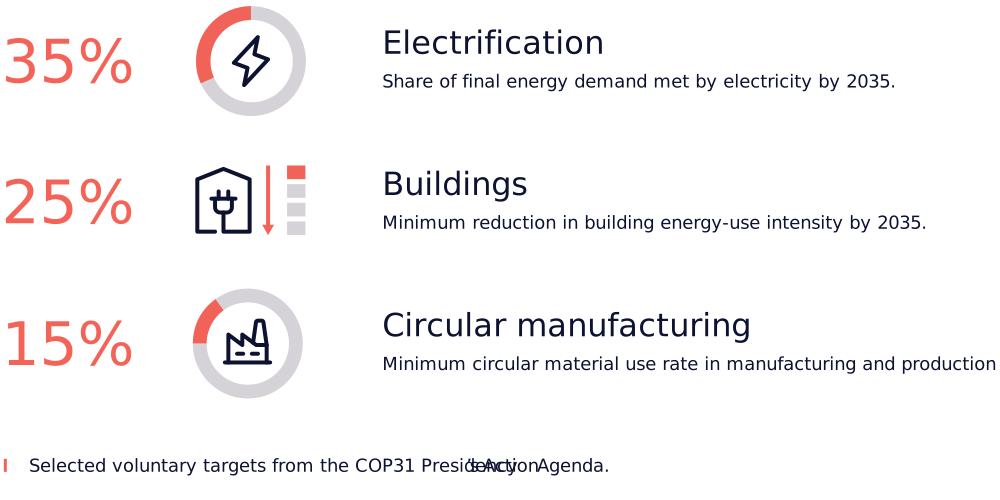
Türkiye has led the development of the COP31 Action Agenda around ten priority themes: Zero Waste, Oceans and Seas, Food Security, Climate-Resilient Cities, Climate Implementation Bridge, Youth and Education, Green Industrialisation, Clean Energy Transition, Rio Conventions Synergy, and Dynamic and Resilient Health Systems. The Presidency has attached measurable 2035 targets to these themes, including:
- Electrification: raising the share of final energy demand met by electricity from just over 20% today to 35% by 2035.
- Waste and methane reduction: halving growth in global waste by 2035.
- Resilient cities and buildings: reducing energy-use intensity in the building sector by at least 25% by 2035.
- Green industrialisation: increasing the circular material use rate in manufacturing and production to at least 15% by 2035.
- Youth, education and food security:ensuring young people everywhere have access to climate education and that young farmers receive training in climate-resilient agricultural practices.
- Climate Implementation Bridge: expanding the Climate Implementation Bridge (CIB) to help countries turn their NDCs into investable project portfolios.
Zero waste is the centre stage of Türkiye’s priorities. The Presidency frames waste reduction as one of the fastest routes to climate results, noting that methane is responsible for around 30% of current global warming.
While the Action Agenda is voluntary, these areas signal where the Presidency will focus political capital and partnerships, and where it will seek to corral public and private sector commitments for capital flows.
President of Negotiations
Australia’s stated focus at COP31 is on speeding up the global shift to clean energy, boosting finance and investment, growing the green economy and elevating Pacific priorities. Its specific negotiating priorities include scaling ambition for 2035 NDCs, adaptation finance, operationalising the just transition mechanism, improving finance access for Small Island Developing States (SIDS) and least developed countries (LDCs), ocean action and global electrification. Australia has committed to an approach that is transparent, inclusive and consultative, and shaped by First Nations voices, knowledge and leadership.
Australia’s role and perceived domestic ambition has also brought scrutiny. Australia’s position as one of the world’s largest exporters of coal and liquefied natural gas drew criticism during the contest to host COP31, and Pacific leaders have again challenged the continued approval of fossil fuel projects both in the lead-up to and during Pre-COP. Australia’s own 2035 target of a 62–70% reduction in emissions below 2005 levels, adopted in September 2025 following the Climate Change Authority’s advice, will be measured against its call for other Parties to scale ambition.
Pacific Partnership
Pacific priorities are central to Australia’s approach, reflecting the reality that for the region climate change directly affects communities’ livelihoods and, in the case of some small island developing states, poses immediate risks to security and sovereignty. Through the COP31 Pacific Partnership, Australia and Pacific partners are elevating four regional priorities:
1.5°C: keeping the 1.5°C temperature goal within reach.
- Finance access: improving access to climate finance.
- Ocean: elevating the ocean as central to the world’s climate and a critical pillar of climate resilience.
- Pacific leadership: amplifying Pacific voices and leadership.
The partnership is advancing a practical agenda, led by three Pacific Climate Envoys, that includes a proposed declaration on fairer climate finance access, Blue Pacific Ocean action, and the capitalisation of the Pacific Resilience Facility (a Pacific-led, owned and managed climate and disaster resilience fund). Türkiye and Australia will also host a COP31 session on the climate finance needs of SIDS. Türkiye has committed to work towards an Antalya Ocean Declaration recognising the ocean-climate nexus.
Pre-COP, held in Nadi, Fiji from 5 to 8 October 2026, was an example of this partnership. Leaders attending Pre-COP adopted the Taku Pakasoa Declaration in Tuvalu and Fiji, calling for collective action on 1.5°C, climate finance, resilience and ocean protection, and inviting other Parties to associate themselves with it ahead of COP31. Around 30 countries have supported the Declaration, although Pacific leaders have stressed that it must be matched by measurable delivery in Antalya.
Key negotiation issues and outcomes sought at COP31
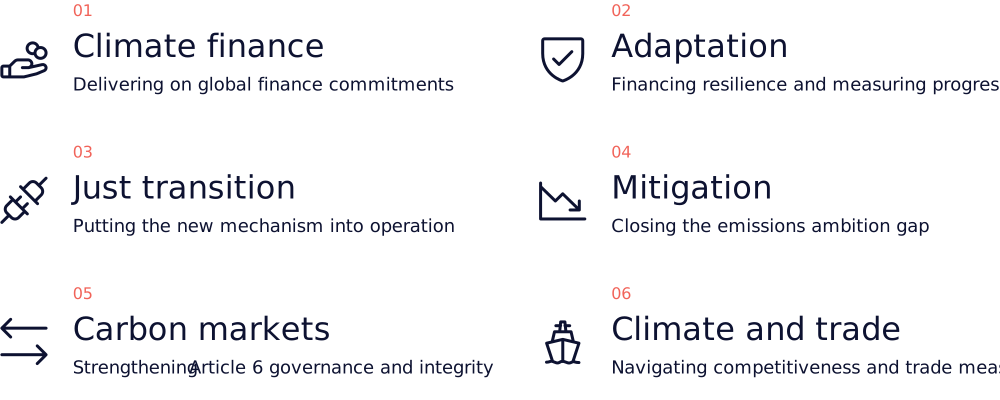
Securing climate finance for developing nations will again be a defining agenda item. At COP29, Parties agreed the NCQG of at least USD300 billion per year by 2035, together with a call to scale up finance to USD1.3 trillion per year by 2035 from all public and private sources. COP31 is the first conference at which Parties must show how those goals will be delivered.
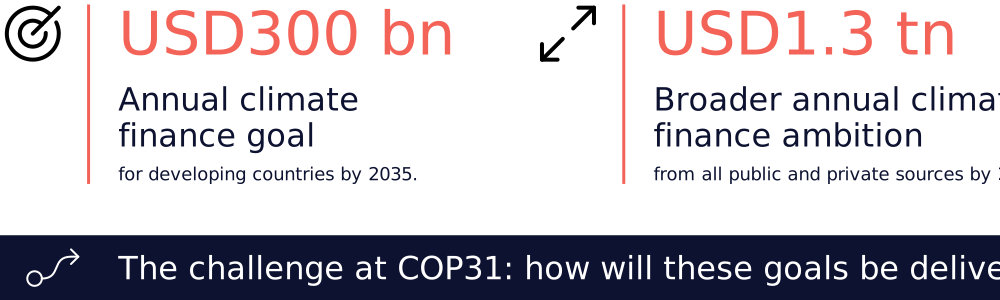
Although developed-country climate finance reached a record USD 136.7 billion in 2024, aid cuts since then (particularly by the United States) are expected to have reduced public climate spending, and developed countries have been slow to come forward with new pledges.
At COP30, Parties agreed to launch a two-year work programme to address Article 9.1 of the Paris Agreement in the context of Article 9 as a whole. This compromise bridged the divide between developing countries seeking a dedicated space to hold developed countries to their public-finance obligations and developed countries insisting on a broader programme covering all sources, including private capital and contributions from wealthier developing countries. The scope and objectives of that work programme are now a central issue for negotiations.
At the June 2026 intersessional meetings in Bonn (SB64), Parties remained divided on the scope, focus and outcome of the work programme. The G77 and China continue to press for the launch of a work programme at COP31 with a dedicated agenda item focused on developed countries’ legal obligation to provide public finance under Article 9.1. As part of this push, they have refused to support intersessional work until Parties agree its modalities. Developed countries want a broader programme covering all sources, including private capital and contributions from wealthier developing countries, and the EU has signalled that it will not bring new finance commitments to Antalya.
The COP30 Presidency-led Baku to Belém Roadmap will seek to give substance to the USD 1.3 trillion goal, although how private capital can be mobilised at the scale required continues to divide Parties.
The finance agenda also includes institutional decisions, including guidance to the Green Climate Fund, the Global Environment Facility and the Fund for responding to Loss and Damage (FRLD), and the seventh review of the Financial Mechanism. Both Presidency leaders have identified public finance and access to finance as priorities.
Loss and damage remains a significant pressure point. The FRLD has set aside USD 250 million for its first round of grants under the Barbados Implementation Modalities for 2025 and 2026, but funding requests in its pipeline total USD 2.8 billion across 119 countries, with SIDS and LDCs accounting for around 61% of the amount requested. With the Fund’s first replenishment due to begin in 2027, the guidance agreed in Antalya will be an early signal of contributors’ willingness to close that gap.[
Access to finance, which both Presidency leaders have identified as a priority, is where the Presidency is best placed to deliver. The Alliance of Small Island States (AOSIS) and the LDCs have welcomed the Presidency’s proposed joint declaration and action plan to improve access to finance for SIDS and LDCs.
Adaptation is a stated COP31 priority for both Presidency leaders, and it is likely to be among the most contested areas in Antalya. COP30 called for efforts to at least triple adaptation finance for developing countries by 2035, but left critical details unresolved, including the baseline for tripling, the contributing Parties and the types of finance that count towards the goal.
At COP31, the central question under the Global Goal on Adaptation (GGA) agenda item is whether the tripling target is written into the GGA text. Developing countries want it included, while several developed countries argue that finance should be dealt with elsewhere. These divisions stalled the GGA negotiations at SB64, where Canada, Norway and Japan were among those opposing a reference to the tripling target, and the issue was deferred to Antalya. The EU is expected to signal support for delivering the tripling goal, and AOSIS and other small island states have made clear that a weak outcome would be unacceptable. The mandated Baku high-level dialogue on adaptation will also be convened in Antalya. Potential outcomes range from a decision clarifying the baseline and contributors for the tripling goal to a narrower, procedural outcome that defers the finance questions.
COP30 also adopted 59 indicators to measure progress toward the GGA, with a two-year Belém–Addis vision to refine the underlying methodologies. COP31 will need to agree the composition of the taskforce to carry this work forward if the indicators are to become operational, and to progress the Baku Adaptation Roadmap as a framework for coherent adaptation action.
Adaptation finance is one of Australia’s stated negotiating priorities as President of Negotiations. The approach to indicators will increasingly shape how adaptation progress is measured and financed, with implications for infrastructure owners, insurers and lenders assessing physical risk and resilience investment.
One of the most significant outcomes of COP30 was the agreement to develop a centralised just transition mechanism. COP31 will negotiate the draft text on the mechanism’s purpose, functions and governance. Parties will consider a draft decision on the process for operationalising the mechanism, alongside terms of reference for the review of the UAE just transition work programme and a mandated high-level ministerial round table on just transition.
The central question is whether the mechanism will have meaningful delivery functions or operate primarily as a coordination and knowledge platform under the work programme. Key unresolved questions include the mechanism’s institutional form, the role of non-Party stakeholders, linkages to the financial architecture and the relationship between trade measures and just transition. Proposals now extend well beyond workforce transition to include grant-based finance, technology transfer, investment de-risking and access to markets.
Operationalising the just transition mechanism is one of Australia’s stated negotiating priorities as President of Negotiations.
The ambition gap remains wide. The 2026 NDC Synthesis Report, published on 27 October 2026, projects that implementation of new NDCs would see global emissions peak and decline to 6% below 2019 levels by 2035 (around 9% if conditional elements are fully implemented), far short of the roughly 60% needed for 1.5°C, and the Presidency continues to urge Parties that have not submitted post-2030 NDCs to do so. The Sharm el-Sheikh Mitigation Work Programme (MWP), the only formal agenda item dedicated to managing emissions, comes to Antalya without an agreed text after negotiations stalled at SB64, and its current mandate expires in 2026. The core divide is between Parties seeking normative signals on emissions reductions and those that view the programme as a non-prescriptive exchange. The EU wants COP31 to provide adequate space to discuss mitigation and has floated extending the programme to 2040, with a focus on clean electrification.
The roadmap on transitioning away from fossil fuels, pursued by the COP30 Presidency after a formal decision was blocked, remains outside the negotiated text. The First Conference on Transitioning Away from Fossil Fuels, held in Santa Marta, Colombia in April 2026, co-hosted by Colombia and the Netherlands with 57 participating countries (including Australia), launched a voluntary coordination process intended to feed a global fossil fuel roadmap into COP31, with a second conference planned for early 2027. The EU, AOSIS and the LDCs all want the transition away from fossil fuels reaffirmed in Antalya, while producer states continue to resist. Australia was one of 24 initial signatories to the Belém Declaration on the Transition Away from Fossil Fuels at COP30, which will draw attention to how it handles this issue as President of Negotiations.
COP31 is also expected to launch the second Global Stocktake (GST-2), where the most contentious design question is whether the IPCC’s Seventh Assessment Report will be available in time to feed into the process. Potential outcomes include a decision continuing the MWP, procedural arrangements for GST-2 and political recognition of the fossil fuel roadmap and the Presidency’s 35-by-35 electrification target, although a negotiated commitment on fossil fuels is less likely. Signals on mitigation and the GST will influence policy settings, investor stewardship expectations and transition plan disclosures under Australia’s mandatory climate reporting regime, which now extends to Group 2 entities for reporting periods commencing on or after 1 July 2026.
With the Article 6 rulebook largely settled, the most contentious issue is the Adaptation Fund’s transition to serve exclusively under the Paris Agreement, which will allow it to receive a 5% share of proceeds from the Article 6.4 mechanism. The sticking point is the membership of its board, which reflects the 1992 distinction between Annex I and non-Annex I countries. Governance arrangements remain unresolved ahead of Antalya, where draft decisions completing the transition are expected to be considered.
Parties will also focus on the significant funding gap for Article 6.2 infrastructure, which the UNFCCC secretariat has estimated at USD 8-9 million for registry and related systems. As discussed in a our previous insight on COP30, the first technical expert reviews revealed considerable shortcomings, including on environmental integrity. Meanwhile, the Paris Agreement Crediting Mechanism is now approving methodologies, and its Supervisory Body is developing standards on baselines, additionality and leakage. Buyer countries and market participants want predictable, workable rules, while some developing countries and civil society prioritise integrity and safeguards. The agenda is likely to include guidance from Parties to the Supervisory Body, and further guidance on Article 6.2 reporting.
COP30 established the first-ever UNFCCC dialogue series on climate change and trade, with a report to a high-level event in 2028. Developing countries argue that unilateral measures, in particular the EU’s carbon border adjustment mechanism (CBAM), raise compliance costs and restrict market access, while developed countries defend them as legitimate responses to environmental externalities. With the dialogue running in parallel, a substantive negotiated outcome on trade at COP31 is unlikely, but the issue may surface in the just transition and response measures texts.
The response measures negotiations, including a mandated ministerial round table, remain the principal formal channel for concerns about competitiveness and the distributional consequences of decarbonisation.
On agriculture, a procedural watchpoint is a new Comoros-requested agenda item on sustainable diets, which lacks an agreed substantive mandate.
The Presidency has called on Parties to submit their second Biennial Transparency Reports, due by 31 December 2026, and wants to strengthen accountability through NDCs, national adaptation plans and transparency reporting. 34 Parties will undergo the facilitative, multilateral consideration of progress in Antalya. The quality and timeliness of reporting, including Article 6 reporting, will remain under scrutiny.
On technology, Parties are expected to confirm UNEP as host of the Climate Technology Centre beyond February 2027, with a draft memorandum of understanding to be considered in Antalya, and to consider the third independent review of the Climate Technology Centre and Network, building on the Belém Technology Implementation Programme agreed at COP30.
Disagreements over the role of climate science are expected to intensify in Antalya, with Saudi Arabia and India identified as resisting references to the IPCC, the 1.5°C limit and climate tipping points. A related dispute concerns aligning the timeline of the IPCC’s Seventh Assessment Report with GST-2. Equity is at the core of this issue, with large developing nations arguing that steep cuts would disproportionately burden their economies, while small island states frame breaches of 1.5°C as existential.
The growing acceptance that 1.5°C will be exceeded, reflected in UNEP’s Limiting Overshoot report, has opened a debate over overshoot pathways and large-scale carbon dioxide removal, raising questions about responsibility, cost-sharing and the credibility of the temperature goal itself. The EU has now endorsed the ‘overshoot, peak and decline’ pathway as the best option to return below 1.5°C by the end of the century, while AOSIS has insisted that countries cannot walk away from 1.5°C. How the overshoot science is reflected in negotiations will be a key marker. For carbon markets, it also raises the stakes on the integrity and governance of removal credits.
Beyond the negotiations
Alongside the formal negotiations, two initiatives launched under the Global Mutirão decision at COP30 will be important to watch.
- Belém Mission to 1.5: jointly stewarded by the COP29, COP30 and COP31 Presidencies (Azerbaijan, Brazil, Türkiye and Australia). Shaped through submissions and consultations with Parties, industry, financial actors and civil society throughout 2026, it will culminate in a report released ahead of COP31 setting out high-impact opportunities, barriers and solutions to keep 1.5°C within reach and strengthen NDCs and national adaptation plans.
- Global Implementation Accelerator: a voluntary, facilitative initiative under the joint guidance of the COP30 and COP31 Presidencies, intended to accelerate implementation across all actors and support countries in delivering their NDCs and national adaptation plans.
Both initiatives may provide an early signal of where governments will focus policy and investment support, and an opportunity to engage directly with the Presidencies on practical barriers to project delivery and finance.
The International Court of Justice’s (ICJ) landmark Advisory Opinion on the Obligations of States in respect of Climate Change, delivered unanimously on 23 July 2025 and welcomed by the UN General Assembly in May 2026, will form an important part of the legal backdrop in Antalya (see our previous insight for our analysis of the Opinion).
Although advisory opinions are not binding, climate-vulnerable Parties and observers are expected to invoke the ICJ Advisory Opinion in Antalya, particularly on NDC ambition, finance and fossil fuel expansion, and it is already being taken up by courts and policymakers. The Opinion and its implications for State obligations and climate accountability is a focus of a number of side events at COP31. Its domestic influence is also rapidly growing: the Opinion has now been referenced for the first time by the High Court of Australia, in the judgment of Gordon J in the Court’s first climate-related decision, MACH Energy v DAMSHEG [2026] HCA 35 (see our insight on the decision).
Potential opportunities
The outcomes in Antalya will help shape climate finance flows, carbon market demand, adaptation investment and the regulatory settings within which the energy transition is financed and built.
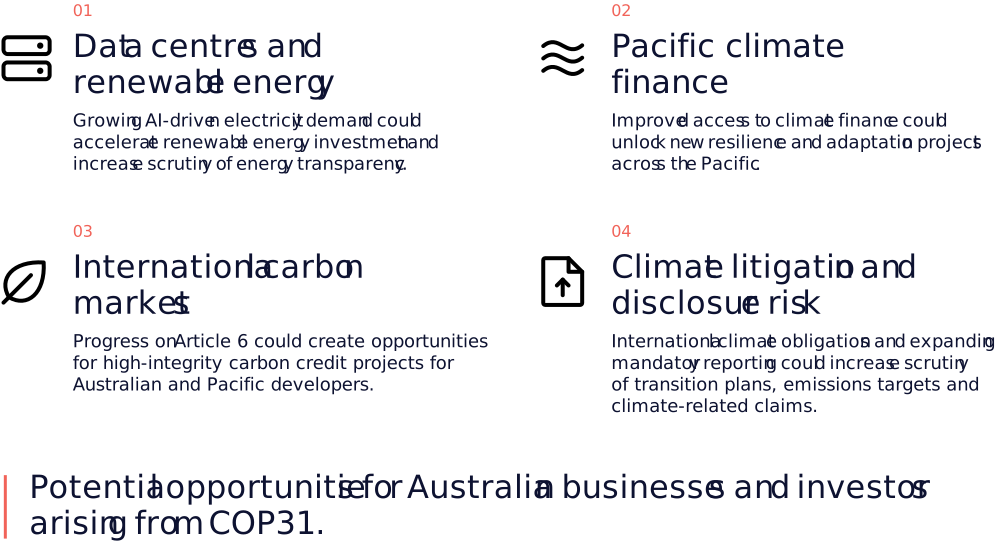
The following trends will be prominent at COP31 and will inform economic and industrial activity in Australia in the years to come:
- Data centres driving renewable investment: AI-driven data centre growth is creating large, long-dated electricity demand. With the Australian Government focused on ensuring data centres underpin new renewable energy investment, expect increased focus on rolling out renewables, and closer scrutiny of energy transparency under the Antalya Pledge on AI. Released by the Presidency in October 2026, the voluntary pledge invites countries, NGOs and financial institutions to make commitments such as requiring providers to disclose their energy and water use. In Australia, the federal Parliament has established a Joint Select Committee inquiry into artificial intelligence, due to report by 30 November 2026, and South Australia has commenced a Royal Commission into Artificial Intelligence.
- Pacific climate finance: improved finance access for SIDS and pledges to the Pacific Resilience Facility could open a regional pipeline of resilience and adaptation projects for Australian financiers, infrastructure providers and advisers.
- International carbon markets: progress on Article 6 governance and Article 6.2 infrastructure could lift international demand for high-integrity credits, creating new revenue streams for Australian and Pacific project developers and land managers alongside domestic ACCUs. This could inform how the Australian Government considers role of international carbon markets and carbon leakage (and a potential Australian CBAM) as part of the ongoing Safeguard Mechanism Review.
- Climate litigation and disclosure risk: the ICJ Advisory Opinion and its endorsement by the UN General Assembly, together with expanding mandatory climate reporting, are likely to sharpen scrutiny of transition plans, emissions targets and climate-related claims. Boards and project proponents should expect greater reliance on international climate obligations in challenges to approvals and government policy, and closer regulatory and stakeholder scrutiny of climate disclosures.
Stay informed on developments at COP31
The team will be on the ground at COP31 in Antalya, tracking the climate change negotiations and reporting on key takeaways and potential impacts for businesses and investors.
For further updates on COP31 and to discuss potential impacts, please contact the Climate Change and Sustainability team.